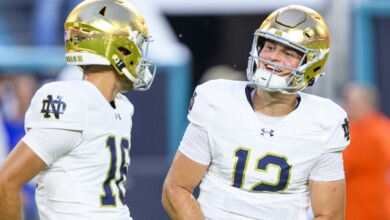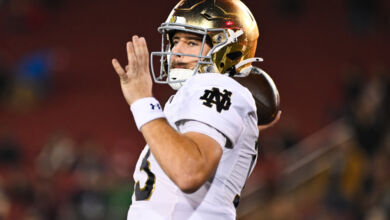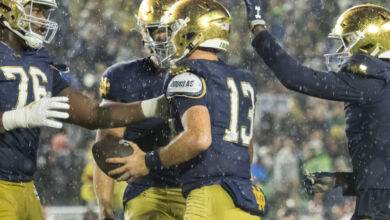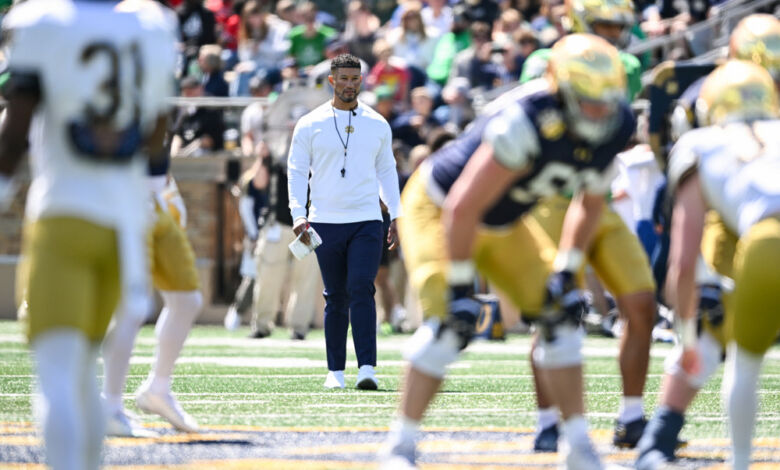
If there was one clear philosophical takeaway from Marcus Freeman’s opening spring press conference, it wasn’t just about who will back up CJ Carr this season. It was about how Notre Dame plans to find its next starting quarterback. If Freeman has his way, that answer won’t come from the transfer portal. It will already be on the roster.
Freeman didn’t shy away from addressing the long-term outlook at the position, even while discussing the ongoing competition behind Carr this spring. In fact, he was unusually direct about where Notre Dame stands.
“I have a strong conviction… that our next starting quarterback – which could be this year if something happens to CJ – is right here in this program.”
That statement carries weight in today’s college football landscape, where quarterback movement through the transfer portal has become the norm. Programs across the country are routinely adding experienced quarterbacks each offseason, often opting for proven production over internal development. Freeman, at least for now, is signaling that Notre Dame wants to operate differently.
A shift from necessity to preference
To understand why this matters, you have to look at how Notre Dame has handled the position in recent years. Early in Freeman’s tenure, the Irish didn’t have the luxury of relying solely on internal development. The quarterback room he inherited was a product of uneven recruiting at the end of the Brian Kelly era, forcing Notre Dame to look outside the program for answers.
That led to back-to-back transfer portal starters. In 2023, the Irish brought in Sam Hartman to stabilize the position with the hope that it would raise the ceiling of the offense. A year later, Notre Dame turned to Riley Leonard to fill the same role. Hartman didn’t exactly work out as planned, while Leonard led the Irish on a playoff run that ended with a championship game loss.
Both moves made sense at the time, and both were necessary given the state of the roster.
But they were also a reflection of where the program was, not where Freeman wants it to be. Now, with a younger, more highly recruited quarterback room in place, as Freeman has gotten the Notre Dame recruiting machine humming, it appears Notre Dame is ready to move into a different phase.
Building instead of buying
That shift is rooted in a clear preference: develop your own quarterbacks rather than relying on the portal as a yearly solution.
“I want to continue to major in developing our quarterbacks in-house and not having to go get a transfer portal quarterback.”
At the same time, Freeman’s stance isn’t absolute. Notre Dame isn’t closing the door on the portal entirely – nor should it. If an elite quarterback were to enter the portal and express interest in the Irish, the program wouldn’t turn away high-end talent on principle alone.
But that’s a very different approach from needing the portal.
The goal now is to avoid annual dependency on outside fixes and instead build continuity within the room. Developing quarterbacks internally allows Notre Dame to establish leadership, accountability, and culture at the most important position on the field rather than resetting that dynamic every offseason with a new transfer.
Letting the competition play out
That philosophy is already shaping how Notre Dame is approaching the current quarterback room.
Behind Carr, the Irish are evaluating Blake Hebert and Noah Grubbs this spring, with Teddy Jarrard set to join the mix this summer. Rather than looking externally for immediate answers, Freeman is allowing that competition to unfold internally.
“You’ll put these guys in game-like situations, see how they perform… and let them compete.”
That approach requires patience – something that hasn’t always been possible in recent years. But for the first time in Freeman’s tenure, Notre Dame appears positioned to evaluate the future of the position without immediately needing outside help.
Results will ultimately decide
While Freeman’s preference is to develop from within, he also acknowledged that belief must be validated over time.
“You’ve got to get through the season and evaluate. Do we believe the future starting quarterback is here in this program?”
That’s the key qualifier. Notre Dame isn’t blindly committing to an internal-only approach. It’s choosing to start there, while remaining flexible if the evaluation changes. If the answer at the end of the season is no, the portal remains an option. But the goal is to not need it.
Developing culture alongside the position
Freeman’s stance isn’t just about roster management; it’s about identity. Developing quarterbacks internally creates continuity within the offense. It allows players to grow within the same system, learn the same terminology, and build relationships over time with coaches and teammates. It also reinforces the importance of recruiting and development, two areas Freeman has emphasized since taking over the program.
Just as importantly, it allows leadership at the quarterback position to emerge organically from within the program – something that’s difficult to replicate when a new transfer is stepping into that role each season.
If Notre Dame can consistently identify and develop its own quarterbacks, it reduces the need for annual resets at the most important position on the field. And after back-to-back seasons of relying on transfers, that kind of stability becomes even more valuable.
A defining stretch for the future
As Notre Dame works through spring practice and into the 2025 season, the quarterback conversation will naturally center on Carr and his development as the starter. But behind the scenes, another evaluation is unfolding – one that could shape the program’s future just as much.
Freeman has made his preference clear. He wants the next starting quarterback to come from within. Now it’s up to the players already on the roster to prove that belief is justified.