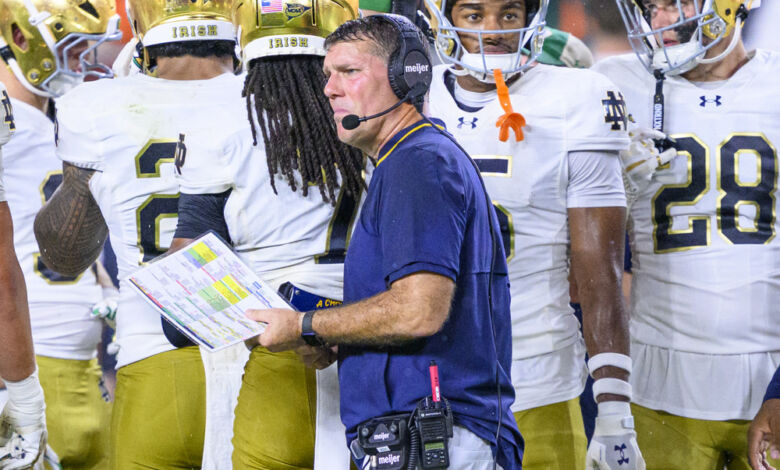
At this time a year ago, Chris Ash was still figuring everything out.
He was learning the roster, building relationships with players and staff, and installing a defensive system on the fly with limited time before spring practice. The narrative was that not much would change from Al Golden’s highly successful sytem, but change with a new defensive coordinator was inevitable. The results early in the 2025 season reflected that adjustment period, as Notre Dame’s defense struggled at times to find consistency — particularly up front.
Fast forward a year, and the situation looks very different.
“Last year at this point I was just trying to get to know the players,” Ash said after Notre Dame’s first spring practice last week. “This year, I understand their strengths and weaknesses.”
That difference alone may be one of the most important developments for Notre Dame heading into 2026.
From Learning to Coaching
Ash’s first spring in South Bend was about learning and installation. This one is about refinement and progression.
With a full season in the system, returning players no longer need to learn the nuances of Ash’s defense from scratch. Instead, the focus shifts to execution, communication, and eliminating the mistakes that showed up on film last year.
“We want to make sure that we take last year’s issues and we eliminate them from the tape this spring,” Ash said. “We don’t want last year’s issues to be today’s problems.”
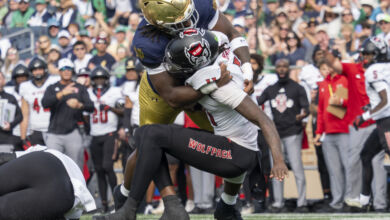
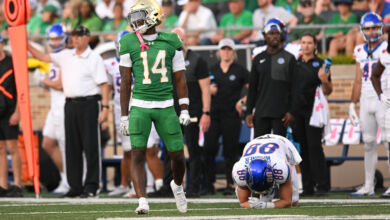
Those problems mainly existed in September last season as Notre Dame dropped back to back games to start the season, including surrendering 40 points to a Texas A&M offense that proved to be anything but explosive the rest of the season.
It was also clear early in the season that Ash was learning about his personnel on the fly as well. Case in point was Notre Dame’s reliance on depth players like Karson Hobbs early in the season when injuries hit the secondary. By season’s end, Hobbs was barely seeing the field.
Rather than spending valuable practice time teaching concepts this spring, Notre Dame can now focus on playing faster and cleaner – something that became increasingly evident as the 2025 season progressed and the defense began to stabilize.
A Defense That Found Its Identity
While the early portion of last season was uneven, Notre Dame’s defense looked like a completely different unit by the end of the year.
The front played with more physicality, the back end communicated more effectively, and the overall structure of the defense felt more cohesive. That late-season improvement is what makes year two under Ash so intriguing.
Instead of building from scratch, Notre Dame is building off something that already proved it could work when it’s players were playing more instinctively than reactively.
And now, Ash has a better understanding of how to deploy his personnel within that system.
Reinforcements Up Front
One of the biggest areas of emphasis this offseason was the defensive line, where Notre Dame lacked consistent size and presence early in 2025.
The additions of transfers Francis Brewu, Tionne Gray, and Keon Keeley should help address that issue immediately, giving Ash more flexibility in how he constructs his front.
“They’re big and physical,” Ash said of the new additions. “They’re really strong. They’re heavy-handed.”
Those additions don’t just improve the defensive line – they impact the entire defense.
A stronger, more consistent front can help control the line of scrimmage, occupy more blockers to free up Notre Dame’s talented linebackers to cause havoc, and reduce stress on a secondary that will be one of the best in the nation. It’s a ripple effect that could elevate the defense as a whole and make what was a great defense even better in 2026.
A New Defensive Staff Dynamic
While Ash benefits from continuity within the system and returning players, he does face a different kind of challenge this spring.
Notre Dame lost three key defensive assistants in the offseason — Mike Mickens, Al Washington, and Max Bullough — forcing a reconfiguration of the defensive staff.
That turnover matters and shouldn’t be dismissed, but the continuity in terminology and scheme should mitigate the learning curve of three new defensive assistants.
Even with a returning coordinator, assistant coaches play a critical role in teaching technique, reinforcing fundamentals, and building relationships within position groups. Replacing that experience is not insignificant, particularly when trying to maintain momentum from the previous season.
One of the most important additions is new defensive line coach Charlie Partridge, who brings both experience and familiarity with some of the incoming transfers. His ability to quickly integrate those players into the system could be a key factor in how fast the defensive front comes together. He also has familiarity with Ash from their time coaching together at Wisconsin.
For Ash, the challenge is balancing continuity in scheme with cohesion among a partially new staff.
Integrating New Players the Right Way
Notre Dame isn’t just replacing coaches – it’s also integrating a significant number of new players, particularly through the transfer portal.
Ash acknowledged that process is ongoing.
“There’s a process for that. We’ve been going through that process for a while,” he said. “We’ve got to do a great job in the meeting – take advantage of every minute that we have with these guys.”
That process isn’t one-size-fits-all.
Even experienced transfers can face a learning curve depending on how different Notre Dame’s scheme and terminology are from what they previously used. That makes communication and teaching especially important during the early stages of spring practice.
At the same time, Ash noted that the new players have already made a strong impression in one key area.
“The new guys in general have done a great job of buying into our culture,” he said. “They’re listening. They’re learning. They’re eager to get out here and go to work.”
That buy-in is essential for a defense that is trying to build continuity while incorporating new pieces.
The Opportunity in Year Two
For Notre Dame, the biggest benefit of year two under Ash is not just familiarity – it’s efficiency.
The defense should be able to install less and execute more. Players should be able to react faster, communicate more effectively, and play with greater confidence in the system.
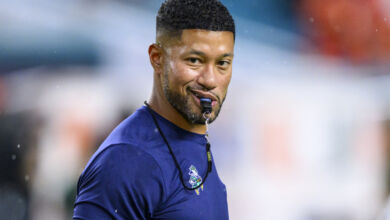
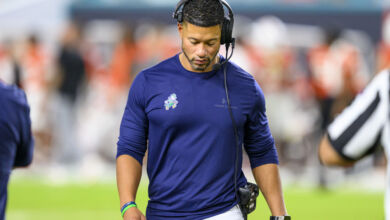
That’s particularly important given the broader theme of the offseason under Marcus Freeman: starting faster.
If Notre Dame is going to avoid the slow starts that have defined recent seasons, the defense will need to be ready from week one. The groundwork for that begins in spring practice.
And for Ash, that means turning last year’s lessons into this year’s results.
Building on a Foundation
Year twp for any coordinator is often where real progress shows up. The foundation has been built. The terminology is understood. The players know what’s expected.
Now, it becomes about execution.
Notre Dame saw flashes of what its defense could be late last season. The question this spring is whether that version of the defense becomes the baseline, or the ceiling.
If it does, the Irish won’t just be more consistent defensively in 2026 and should be one of the more complete units in the country. And that’s the kind of jump year two is supposed to bring.