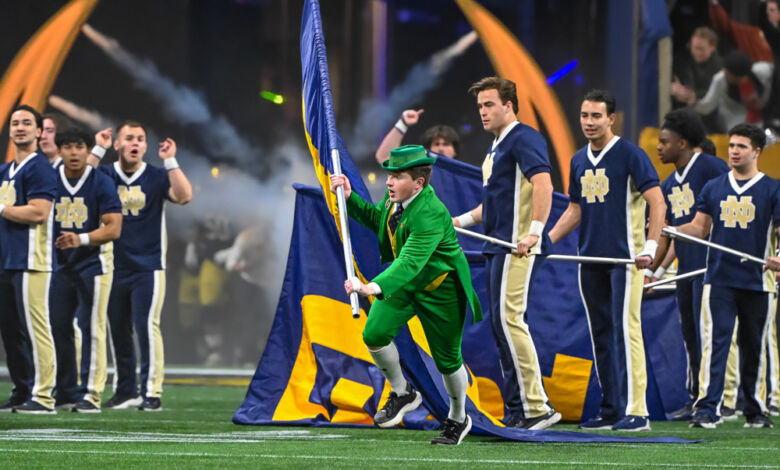
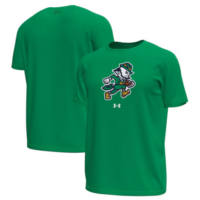
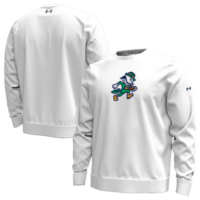
This week, Notre Dame unveiled a fresh alternate version of its iconic Leprechaun logo, the first in a new series of sport-specific marks that will give each program its own twist on the classic design. The update sparked plenty of conversation on Twitter and forums, making it a great moment to look back on how Notre Dame came to be known as the Fighting Irish—a name rooted in Civil War heroics, football folklore, and even a street battle with the Ku Klux Klan – in the first place.
Roots in the Civil War
The roots precede football. During the Civil War, Irish immigrant soldiers serving in the Union’s famed Irish Brigade earned a reputation for valor. Notre Dame’s Rev. William Corby, C.S.C., served as their chaplain and famously granted general absolution to the brigade before the fighting at Gettysburg. That moment permanently tied Notre Dame to a powerful image of Irish courage and sacrifice.
New Notre Dame Leprechaun Gear from Under Armour

The Early Football Folklore
As Notre Dame football rose to prominence in the early 1900s, opposing writers often leaned on ethnic and religious slurs—“Catholics,” “Papists,” or “Dirty Irish.” One enduring legend attributes the nickname to a 1909 game against Michigan, when a halftime exhortation—“What’s the matter with you guys? You’re all Irish and you’re not fighting worth a lick!”—preceded a comeback that some reports credited to the “Fighting Irishmen.” While more legendary than definitive, the story reflects how the moniker fits the team’s underdog grit.
Reframing an Insult
By the 1910s–1920s, Knute Rockne’s teams had put Notre Dame on the national map with the Irish winning National Championship in 1924, 1929, and 1930. Publications preferred “Gold and Blue” or “Notre Damers,” but Rockne’s student press agents and East-coast media began using “Fighting Irish” to celebrate the program’s never-say-die ethos—turning a taunt into a badge of honor.
Why it resonated
- Pride in immigrant Catholic roots during an era of open prejudice
- Tenacity on the field that matched the image the nickname projected
- Media amplification by alumni such as Francis Wallace of the New York Daily News
The Clash with the Ku Klux Klan
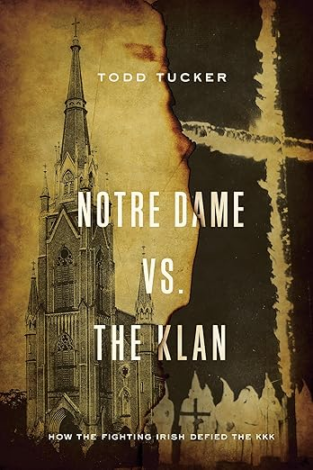
In May 1924, the KKK—then prominent in Indiana—planned a rally in South Bend. About 500 Notre Dame students confronted the Klan: tearing off hoods and robes, chasing marchers, and even hurling potatoes at a lit “fiery cross.” Quarterback Harry Stuhldreher famously knocked out the last stubborn light bulb amid cheers.
Two days later, the students sparked another confrontation involving police and Klan members, organizing “flying wedges”—a nod to football—to fight through. President Rev. Matthew Walsh, C.S.C., climbed a courthouse cannon and urged students to stand down. No fatalities occurred; a few arrests were made, and the Klan never held another rally in the city.
Official Adoption in 1927
By the mid-1920s, “Fighting Irish” was being widely used. In 1927, President Walsh officially codified it, favoring a term that embodied pride and belief over derogatory alternatives—and quickly others like “Catholics,” “Rovers,” or “Ramblers” faded away.
The Leprechaun Logo & Mascot
- Before the leprechaun, Notre Dame used Irish terriers as live mascots—beginning with Brick Top Shuan-Rhu (1930), followed by dogs named Clashmore Mike.
- A human leprechaun first appeared in the 1950s cheer squad; the stylized leprechaun logo was designed by sports artist Ted (Theodore W.) Drake in 1964 for just $50, debuting on a Time magazine cover featuring Coach Ara Parseghian.
- In 1965, the leprechaun was officially adopted as the athletic mascot, replacing the terriers. Since then, it has become one of college sports’ most iconic symbols.
- Just recently (2025), Notre Dame began rolling out sport-specific Leprechaun logo variants, starting with a football version, offering a fresh take while honoring the classic mark.
Legacy of the Fighting Irish
- Courage under pressure — Fr. Corby and the Irish Brigade at Gettysburg
- Defiance in sport — early teams redefining a slur into a standard
- Pride in heritage — de Valera’s 1919 visit and media embrace
- Resistance to hate — students confronting the Klan in 1924, then standing down under Walsh’s command
- A living symbol — the Leprechaun as a spirited, enduring embodiment of the Fighting Irish
Notre Dame’s teams have wrapped themselves in the Fighting Irish name, representing more than just athleticism—they stand for identity, grit, and community.
Notes on Sources
- What’s in a Name — Notre Dame’s official history of the “Fighting Irish” nickname, including President Walsh’s 1927 statement.
- A Clash Over Catholicism — detailed account of the 1924 confrontation between Notre Dame students and the Ku Klux Klan.
- Football, Catholics, and Prejudice — on how slurs and stereotypes shaped early coverage of Notre Dame football.
- Fr. William Corby at Gettysburg — Notre Dame archives on Corby’s absolution of the Irish Brigade.
- Notre Dame Athletics: “The Fighting Irish” — confirms the 1927 adoption and prior nicknames.
- Notre Dame Leprechaun Mascot History — official ND Athletics page on the Leprechaun mascot and logo history.
- Mascot Hall of Fame – The Leprechaun — additional context on the Leprechaun’s adoption and role.
- Irish America: The Origin of the Fighting Irish Nickname — supplemental background on cultural influences and symbols.
*UHND receives affiliate commission from links to Amazon.com and Fanatics.com for Notre Dame-related products mentioned in this post