- Marcus Freeman praised the secondary for playing with “aggression and a hungry mentality.”
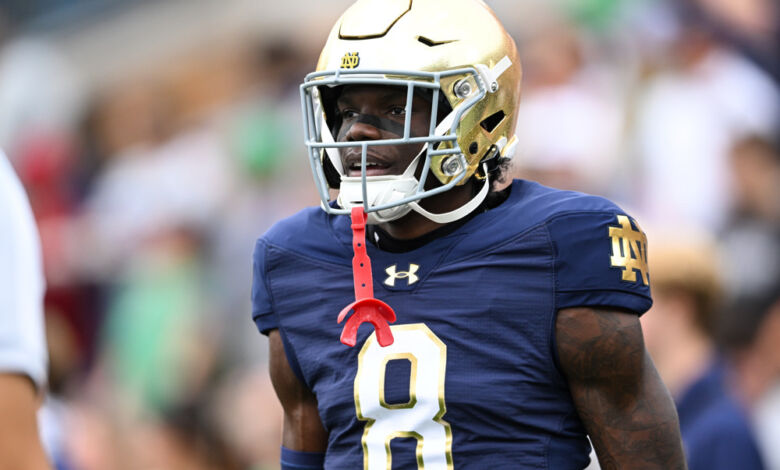
- Adon Shuler’s forced fumble late in the second quarter flipped momentum and led to a quick Irish touchdown.
- Arkansas was held to just 207 passing yards with no completions over 30 yards.
- The unit showed improved communication and confidence despite missing veteran corner Leonard Moore.
For the first two weeks of the season, Notre Dame’s secondary was under siege. Big plays piled up, communication broke down, and criticism mounted as opponents picked apart a unit that had been billed as one of the defense’s strengths. On Saturday in Fayetteville, that same group turned the narrative around.
In a 56–13 rout of Arkansas, the Irish defensive backs played with the aggression and clarity head coach Marcus Freeman had been demanding. They held Razorbacks quarterback Taylen Green to 207 passing yards, produced a game-changing takeaway, and — most importantly — eliminated the back-breaking deep shots that had defined September.
“I think [it was] understanding what they’re being asked to do, playing with an aggression and a hungry mentality,” Freeman said. “It’s a mindset, it’s a preparation, it’s clarity on what you’re being asked to do, and then you got to go out there and do it.”
Shuler Sets the Tone
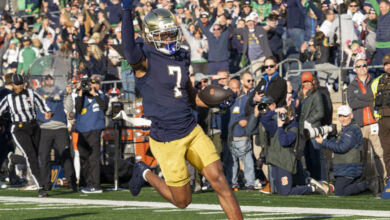
No play embodied the shift more than Adon Shuler’s forced fumble late in the second quarter. With Arkansas driving to stay within striking distance, Shuler ripped the ball free to set up Notre Dame’s offense. Two snaps later, CJ Carr dropped off a short screen to Jadarian Price, who darted 35 yards for a touchdown that broke the game open.
“Just the whole game and the whole week we kind of talked about how we need to get the ball,” Shuler said. “We need to be plus two, and that’s kind of been the focus for me as being a leader — just talking about it on the sideline. We got to get the ball. Our coaches said Arkansas was a team that fumbled a lot, so the second man in has to attempt to rip the ball.”
It was the kind of play the Irish had been missing in the secondary. Instead of reacting to big plays, they created one of their own — and the momentum shift was immediate.
Communicating and Competing
Beyond the forced fumble, Shuler credited the group’s attention to detail and improved communication. With multiple young defensive backs seeing significant snaps, the Irish needed cohesion more than ever.
“Just attention to detail,” Shuler said. “Coaches and players had to harp on finishing and kind of knowing we’re in situations. Having a lot of young guys playing, it was about keeping them confident, keeping their confidence up, and just telling them that when you’re out there, you won.”
The improved communication helped the Irish keep everything in front of them. Arkansas’s longest completion of the day went for 28 yards, and the Razorbacks were shut out after halftime.
“As the season goes on, you build a brotherhood,” Shuler added. “That’s the main focus. We have to play together and play as a unit.”
Limiting Explosives
Freeman had been clear all week: Notre Dame couldn’t keep surrendering explosive plays if it wanted to turn the season around. Against Arkansas, that box was checked.
“There were a couple explosive plays that Arkansas converted. They’re a good offense, top five in the country coming in,” Freeman said. “But I think it was the ability to say, ‘Okay, we can’t give up the explosive.’ There were some explosive runs we obviously can’t have, but I didn’t think they gave up too many explosive passes.”
Instead, the Irish forced Arkansas to drive the field. When the Razorbacks crossed midfield, the defense tightened, holding them to just one touchdown in six red-zone trips.
“Those are four-point swings,” Freeman said of holding Arkansas to field goals. “Those were huge by our defense — the game plan, but also the execution of it.”
Growing Without Leonard
The improved play came without veteran cornerback Leonard Moore, who missed his second straight game. For Shuler, that absence was a challenge — but also an opportunity for others to step up.
“Definitely want to get Lenny back, but the job has to get done no matter who’s on the field,” Shuler said. “That’s the main focus right now. Whoever’s on the field has to do their best and pay attention to details with everything.”
Freshman Mark Zachery saw extended action and helped keep the Razorbacks’ receivers contained, another encouraging sign for a unit that needed confidence.
A Different Mentality
Perhaps the biggest difference wasn’t schematic but a difference in mindset. Early in the game, when Arkansas found some success, it would have been easy for doubts to creep back in. Instead, the secondary stayed composed.
“Just being calm, cool, and collected, not worrying about what everybody says,” Shuler said. “Doing it for the brotherhood and making sure the offense knows we got their back and they got ours.”
That collective mentality mirrored Freeman’s postgame message. For the Irish, improvement was less about one adjustment and more about refusing to pass blame.
“It’s not Chris Ash’s, it’s not one person’s — it’s all of ours. We own this thing,” Freeman said. “And if you have that mentality, then you’re willing to fix it. If you want to pass blame, then you’re never going to do the things it takes to fix it. The leaders on the defense didn’t point the finger. They pointed it at themselves.”
Looking Ahead
Notre Dame still has plenty to clean up defensively, but Saturday in Fayetteville offered a glimpse of what the secondary can be when it plays with confidence and aggression. For a unit that heard nothing but criticism for three weeks, it was a performance to build on.
“We stuck together,” Freeman said. “It was a challenging week, but the leadership from coaches to players really helped us get through it and perform better.”
If the secondary can bottle that mentality, Notre Dame’s defense may not just survive the season’s toughest remaining tests — it might thrive in them.