
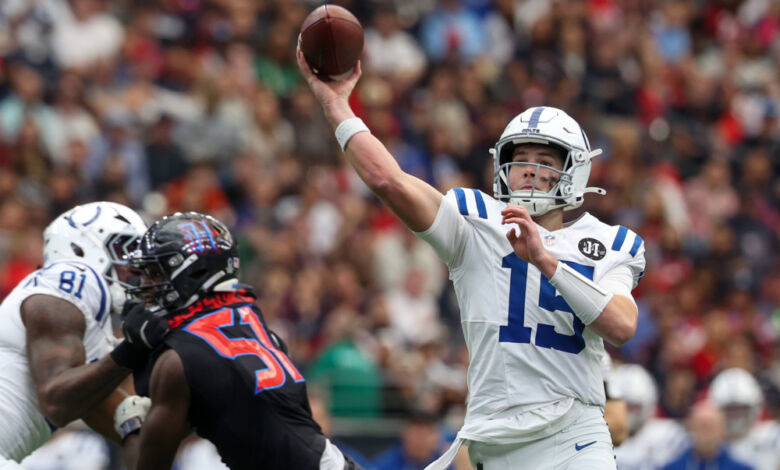
When Riley Leonard made his first NFL start for the Indianapolis Colts, the result looked a lot like the version of Leonard Notre Dame relied on in 2024: productive, competitive, and imperfect — but capable of driving an offense.
Leonard finished the afternoon completing 21 of 34 passes for 270 yards and two touchdowns, added a short rushing touchdown, and accounted for three total scores in the Colts’ 38–30 loss to the Houston Texans. He also threw an interception and lost two fumbles (though one credited to his stat line was on a last play of the game gimmick) — a stat line that, taken as a whole, felt strikingly familiar to those who followed his season in South Bend.
The debut was equal parts promise and reminder.
Early on, Leonard made everyone wonder why the Colts didn’t turn to him sooner instead of dragging 44-year-old Phillip Rivers out of retirement. Throughout the game, however, he showed enough rookie mistakes to remind everyone that he is still a very raw prospect.
Leonard pushed the ball downfield, including a long touchdown strike to Alec Pierce that highlighted both his arm strength and his willingness to challenge coverage. He moved the pocket with his legs, finishing with 21 rushing yards and a score, and put pressure on Houston’s defense by forcing them to account for him as a runner.
That dual-threat element was central to Leonard’s value at Notre Dame. He was never asked to be a pure drop-back passer who carved defenses apart with precision alone. Instead, he was at his best when the offense leaned into his mobility, toughness, and ability to generate explosive plays even when structure broke down. Sunday looked no different.
The mistakes, however, were also part of the picture. An interception and two lost fumbles stalled momentum and ultimately tilted the game out of reach. Those moments underscored the same balance Notre Dame lived with during Leonard’s season in South Bend: aggressive playmaking brings opportunity, but it also carries risk — especially against faster, more opportunistic defenses.
Still, from a Notre Dame perspective, the most telling part of Leonard’s debut wasn’t the turnovers or even the final score. It was that he didn’t look overwhelmed. In his first NFL start, Leonard threw for 270 yards, generated three touchdowns, took some hits, and continued attacking — the exact competitive profile that made him a stabilizing force for the Irish during a transitional year.
For Notre Dame, Leonard was never meant to be a long-term solution or a finished product. He was a quarterback who was meant to be a bridge from the terrible quarterback recruiting from the end of Brian Kelly’s tenure to the CJ Carr era. He brought physicality and athleticism to the position, so much so that offensive coordinator Mike Denbrock struggled to come up with answers on third/fourth and short without having Leonard to run QB Power. Leonard delivered for Notre Dame.
One game won’t define Leonard’s pro career. But for Irish fans watching closely, his debut felt less like a surprise and more like confirmation: this is who Riley Leonard has always been — a resilient, aggressive quarterback whose impact shows up even when the stat line isn’t perfect.
The last fumble was on a last second hook and ladder play and should not even be mentioned. The first was on extremely poor pass protection. The interception was bad but he brought the Colts back against a good defense with no running game to speak of today.
Agree. To call the last fumble as Riley Leonard’s fault, or to suggest it affected the game is irresponsible journalism, or this was written by someone who did not watch the game.