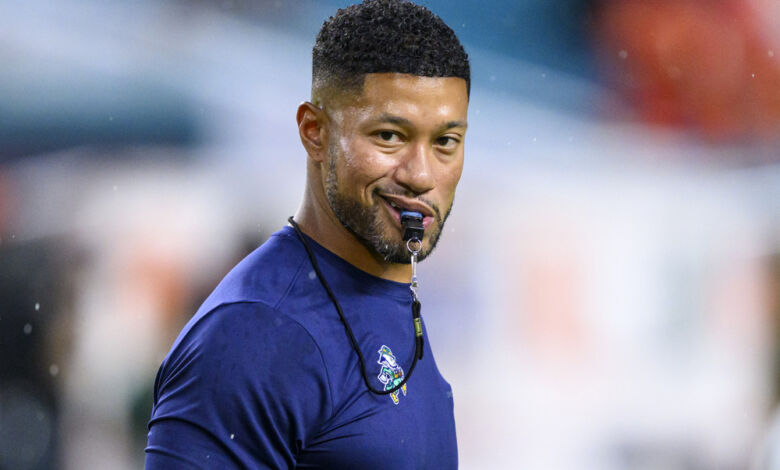
- Freeman emphasized “simplifying the how,” not cutting the playbook down.
- Defense focused on clarity of assignments and situational mastery.
- Pattern-match practice periods helped the secondary handle coverage responsibilities.
- Improved execution, not new calls, fueled the Week 4 turnaround.
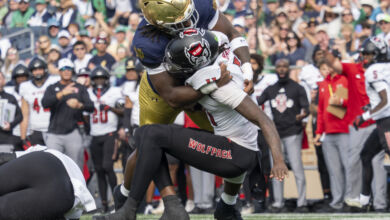
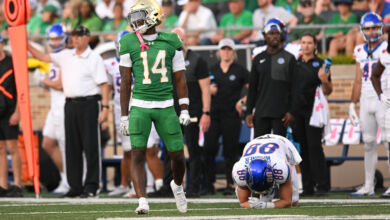
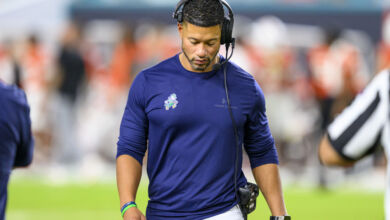
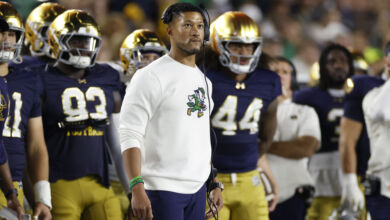
Marcus Freeman has spent the last two weeks hammering a single theme into his program: growth comes from being uncomfortable. After Notre Dame’s defense was torched for explosive plays in a 41-40 loss to Texas A&M, discomfort was unavoidable. The Irish had to face their flaws head-on. Against Arkansas, they showed progress, holding the Razorbacks in check for much of the game.
The difference? According to Freeman, it wasn’t about cutting the playbook or reinventing the scheme. It was about simplifying the execution.
“I just think different coordinators have different philosophies of defense,” Freeman explained this week. “When you have that experience from the NFL, you probably have a lot of answers. But answers are only as good as execution. Sometimes through failure, you got to say, ‘Okay, this looks good on paper, but our guys aren’t executing at the level we need them to execute.’”
That admission reveals the shift that took place between Weeks 3 and 4. Instead of loading players with too many checks, too many variations, and too many “what ifs,” the Irish staff honed in on the fundamentals. The calls themselves didn’t change much. What changed was the way they were taught and practiced.
Speed Through Clarity
Notre Dame’s defensive players were noticeably faster and more confident against Arkansas. The secondary, in particular, played with aggression, closing on routes and limiting the kind of breakdowns that had plagued them in previous weeks.
“I think what you saw in some zone coverage,” Freeman said, “we were intentional about working more pattern-match type periods in practice to making sure our guys understand, okay, here’s cover four, here’s cover three, here’s cover two. What is this offense going to try to do to attack these different coverages? Let’s make sure you have clarity on how they’re going to try to attack us. Then you can be aggressive in jumping routes and things like that.”
That clarity showed up in real time. Instead of chasing the game, Notre Dame dictated more often. It wasn’t about dropping into softer zones or scaling back aggression; it was about knowing when to trigger, when to sit, and how to react to the opponent’s tells.
Situational Masters
One of the coaching points Freeman and Chris Ash hammered home was becoming “situational masters.” That means understanding down-and-distance and what offenses are most likely to do in those moments.
The result was a defense that wasn’t guessing. Players were attacking with knowledge, not hesitation. “We cannot give up the explosive plays that we gave up the week before,” Freeman said bluntly. “That can’t happen. We got to keep the ball in front of us. That was definitely a mindset going into the game, and that could be technique-driven. But the other part of it is being situational masters and understanding when you can be aggressive because of the down and distance.”
The payoff came in the form of a secondary that looked connected for the first time this season rather than fractured. Safeties weren’t late to rotate, corners weren’t bailing too deep, and the Irish forced Arkansas to string drives together rather than landing haymakers.
Simplified Doesn’t Mean Small
The key message from Freeman was that Notre Dame didn’t reduce the defense. They still had answers in the playbook. They just taught fewer variations of each concept.
“You can play cover three five different ways,” Freeman explained. “Or you can play cover three one or two different ways. And I think that’s maybe how you saw us simplify.”
That distinction matters. Simplifying didn’t mean surrendering flexibility or making the defense predictable. It meant focusing on execution at full speed.
The results were obvious. Arkansas still found some success on the ground—especially with quarterback scrambles—but the wide-open shots in the passing game that doomed Notre Dame against Texas A&M were nowhere to be found.
The Next Test: Boise State
The Irish won’t get much time to enjoy their defensive rebound. Boise State arrives at Notre Dame Stadium this weekend with one of the most explosive offenses in the country, averaging more than 500 yards per game.
“They got a good quarterback that’s experienced, that’s tough, gritty, takes care of the ball,” Freeman said. “Their offense is explosive. It’ll be a good challenge for our defense again.”
For Notre Dame, the formula doesn’t change. The calls themselves will remain largely the same. What will determine the outcome is whether the defense can continue playing fast, clear, and confident.
“We better find ways to teach it better,” Freeman admitted. “How we played was simplified, right? Maybe less checks, maybe less versions of playing this type of defense. That’s maybe how you saw us simplify.”
If the Irish can replicate the clarity and confidence they showed against Arkansas, the defense may finally be settling into the kind of rhythm Freeman has been pushing for all season.