
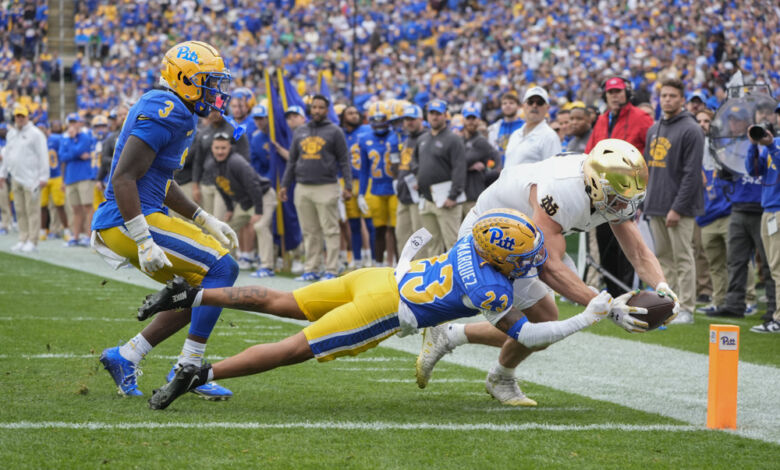
Notre Dame walked out of Pittsburgh with a convincing 37–15 win, one of their most impressive road performances of the season. The Irish were better in nearly every phase — more physical, more explosive, and more disciplined — and the game never felt competitive after the opening minutes. But even inside a dominant effort, a familiar issue resurfaced: Notre Dame’s red-zone execution.
For yet another time this season, the Irish moved the ball with ease between the 20s, only to lack execution goal line. Against Pitt, Notre Dame reached the red zone three times and scored on only two of those trips. The lone failure — a 14-play, eight-minute drive that died at the 1-yard line — was a textbook example of the bigger pattern developing this season.
Through ten games, Notre Dame has made 47 red-zone trips and scored on 35 of them (74.5%). That number may not look terrible, but it ranks #122 in the country in redzone scoring percentage, making the Irish one of the absolute worst teams in the country at scoring when it should be the easiest. Up close, it’s messy: twelve empty trips with six turnovers on downs, four missed field goals, and two interceptions. The closer you zoom in on the last month, the clearer the problem becomes.
Notre Dame red-zone TD rate over the last four games: 10-for-16 (62.5%).
Red-zone scoring of any kind over the last four: 12-for-16 (75%).
Those are not numbers consistent with the kind of November finishing that decides tight games.
And the Pitt game followed the same script.
Notre Dame’s best drive of the afternoon — fourteen plays, 74 yards — should have put the Irish up three scores and buried the game early. Instead, it ended with four snaps inside the five, a stuffed run, a missed throw, a tight-window attempt that came up short, and a fourth-down incompletion. All the ingredients of Notre Dame’s season-long red-zone inconsistency were on display in one sequence.
Notre Dame has also struggled in short-yardage situations, with offensive coordinator Mike Denbrock seemingly unable to come up with any solution now that he can no longer just rely on QB power with Riley Leonard as he did a year ago. Notre Dame’s failed fourth down inside the one-yard line was a classic case of a coach not trusting his personnel and only out-smarting himself. Jeremiyah Love is the best running back in the country, but Denbrcock called a fade to a player who has yet to score a touchdown this season, Eli Raridon, then handing the ball to a player that will almost certainly be selected in the top 5 of next year’s NFL Draft.
Notre Dame could have at least attempted a pass to its contested catch monster Malachai Fields instead. For some reason, the Irish have shied away from going his way at times in the redzone despite Fields’ dominance at contested catches this season – Fields is 10 for 18 on contested catches and has just one drop all season long.
Last year, Riley Leonard would have had his number called before it got to fourth down and the drive probably would have ended in a touchdown. Riley Leonard isn’t walking through the door to solve the problem this year, however, and Denbrock needs to find a way to solve the problem without the security blanket of a 6-4, 215 lbs quarterback capable of powering his way forward in those instances. So far this season, Denbrock has not shown that he is capable of doing that.
The Irish eventually cruised anyway. But in a closer game against better competition – like the Irish hope to be facing in the postseason – this kind of stalled trip is the difference between a win and a loss. With a freshman quarterback, a still-forming offensive identity inside the 10, and the stretch run ahead, red-zone efficiency is the one area Notre Dame can’t afford to let lurk in the background.
Why It’s Happening
Some of the struggles are predictable for a freshman quarterback. C.J. Carr has been exceptional between the 20s, where spacing, leverage, and timing all work in his favor. But inside the 10, everything compresses. Throws must come earlier, anticipation must be sharper, and ball placement must be perfect. Two of Notre Dame’s red-zone issues at Pitt were simply plays where Carr didn’t beat the coverage with timing and location.
But it isn’t all on him.
Short-yardage push has been inconsistent. Notre Dame ran for 175 yards at Pitt, including 147 from Jeremiyah Love, yet couldn’t consistently create leverage when the field shrank. Too many runs get bounced or stopped for minimal gain as the Irish get closer to the endzone. Too often, the Irish seem unsure of their red-zone identity — are they a power-run team, an air-raid team, or an RPO team when the windows tighten?
Between the 20s, the offense is crisp and explosive. Inside the 20, it feels like a unit still figuring out what it wants to be.
All of this is compounded by the fact that Notre Dame also cannot trust its field goal kicking operation at the moment. Noah Burnette’s early-season injury that has lingered and prevented him from kicking has forced freshman Eric Schmidt into action, and the frosh has missed all of his field goal attempts this season, including a rather ugly miss on Saturday.
November football shrinks games. Drives matter more. Finishing matters more. Red-zone sharpness is the difference between ending a game early and letting an opponent steal one late. And the games will not get any easier in December and beyond.
Notre Dame Red-Zone Performance by Game
| Opponent | RZ Performance | Reasons for Failed Drives |
|---|---|---|
| Miami | 3/3 (100%) | — |
| Texas A&M | 5/5 (100%) | — |
| Purdue | 3/4 (75%) | Missed FG |
| Arkansas | 5/5 (100%) | — |
| Boise State | 3/4 (75%) | Missed FG |
| NC State | 5/8 (62.5%) | Turnover on downs, Missed FG, Interception |
| USC | 4/7 (57%) | Turnover on downs, Missed FG, Interception |
| Boston College | 1/3 (33%) | Turnover on downs, Fumble |
| Navy | 4/5 (80%) | End of half |
| Pitt | 2/3 (67%) | Turnover on downs |
Season Total: 35/47 (74.5%)
Empty trips: 12 (6 turnover on downs, 4 missed field goals, 2 interceptions, 1 fumble, 1 end-of-half)
What the Trend Shows
Notre Dame started the season finishing drives at an elite level — 13-for-13 in the red zone through two games – ironically, both losses. Since then, the Irish have gone just 22-for-34 (64.7%). The problem isn’t getting to the red zone; it’s getting out of it with seven points. That pattern hasn’t flipped yet, and the Pitt game was another reminder that this may be the one flaw separating Notre Dame’s offense from its true ceiling.
Notre Dame is surging in almost every other area — explosive plays, offensive balance, defensive pressure, and situational control. Fixing the red zone is the last significant step. And if the Irish get that part right, there’s another level this team can reach as it hopefully heads towards the playoffs. If they are not able to find some answers, though, not being able to kick field goals or finish drives inside the redzone could be the ultimate undoing of this year’s Fighting Irish. It will also lead to a lot of questions as to why Notre Dame’s high-priced offensive coordinator was unable to solve the problem with the nation’s most talented backfield and a receiving corps that features a monster like Fields and shifty receivers like Will Pauling and Jordan Faison.
Great analysis! Denbrocks call of a fade at the 1/2 yard line was ridiculous! Carr with a push from Love could have leaned into the end zone! Carr had no business going shotgun.
Tom Brady was great at the QB sneak & he was not a “great athlete.” Is that something that can be taught, or is it just a knack that people either have or don’t have? CJ Carr is plenty big. Why can’t they call his number like they did with Riley Leonard? He scored on a QB power run yesterday. Are they scared he’ll get hurt? How about putting him under center & using 2 running backs in the backfield?