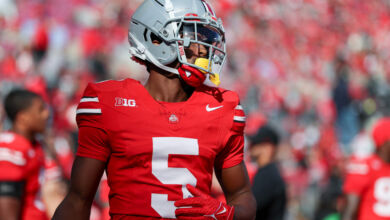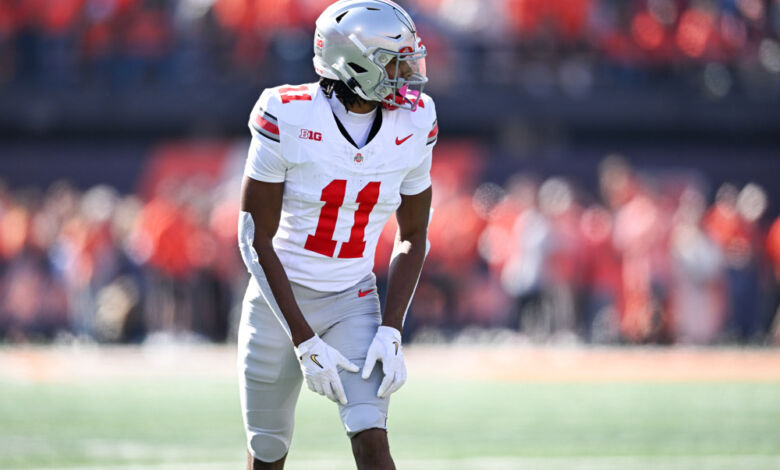
Notre Dame added another significant piece to its 2026 roster this week, landing former Ohio State wide receiver Quincy Porter out of the transfer portal. The addition continues a productive stretch for the Irish after a slow start to the portal window and reinforces Notre Dame’s focus on upgrading an already talented roster with high-upside pieces.
Porter arrives in South Bend with three years of eligibility remaining and immediately becomes one of the more physically intriguing wide receivers on the roster.
A High-End Recruit with a Proven High School Resume
Porter came to Ohio State Buckeyes as one of the top wide receiver prospects in the 2024 recruiting class. A consensus four-star recruit out of Bergen Catholic High School in New Jersey, he was widely viewed as a prototype boundary receiver with elite size and long-term upside.
His high school production backed that evaluation. Over three varsity seasons at Bergen Catholic, Porter totaled 133 receptions for 2,624 yards and 38 touchdowns, consistently producing against one of the toughest schedules in the Northeast. As a senior, he posted 57 catches for 969 yards and 11 touchdowns, averaging more than 80 receiving yards per game.
Porter chose Ohio State over a deep offer list that included Penn State, Michigan, Oregon, USC, Miami, and Tennessee, opting to bet on long-term development in one of the country’s most talent-rich wide receiver rooms.
Playing Behind NFL Receivers at Ohio State
Porter’s lack of collegiate production should be viewed almost entirely through the lens of opportunity. Ohio State’s receiver room has been a yearly logjam of future NFL players, and breaking into the rotation as a young player is notoriously difficult. Porter did not record any official statistics during his time in Columbus, but that will happen when there are early round NFL draft picks playing ahead of you on the the depth chart like Carnell Tate and Jeremiah Smith.
That reality became even more complicated with Ohio State losing longtime wide receivers coach Brian Hartline, adding developmental uncertainty for younger receivers still trying to establish a role. For Porter, the portal represented a chance to reset and find a clearer path to playing time.
Why Notre Dame Makes Sense
From Notre Dame’s perspective, Porter fills a profile the Irish have been expected to target in the portal. He is a true boundary “X” receiver, standing around 6-foot-4 with the frame and catch radius to win on the outside and be a factor in the red zone. That skill set complements a receiver room that has leaned more toward versatility and movement-based players in recent seasons and replaces what Notre Dame lost with Malachai Fields out of eligibility.
The Irish return Jordan Faison and Jaden Greathouse in 2026, but depth and availability remain questions. Greathouse flashed star potential during Notre Dame’s 2024 College Football Playoff run before injuries limited his impact again last season, highlighting the need for more size and reliability on the perimeter.
Porter likely arrives with the expectation that he will be Notre Dame’s starting boundary receiver, with the Irish lacking a true boundary receiver ready for a prominent role in 2026. Notre Dame needed a boundary receiver in this portal cycle and they added one with perhaps the highest upside of any available in the portal. The Irish publicly lost out on Nick Marsh of Michigan State in the opening weekend of the portal, but an argument could be made that the Irish ultimately landed a more talented option with more upside. Porter ranks as the #3 wide receiver and #21 transfer overall according to the On3 industry rankings.
Momentum Building in the Portal
Porter’s commitment is part of a broader shift for Notre Dame after an opening week of the portal that was defined more by near-misses than wins. Defensive tackle Xavier Gilliam was among the visitors who ultimately signed elsewhere, keeping defensive tackle as the program’s most pressing need.
Still, adding Porter represents exactly the type of move contenders make. While Notre Dame must continue to address the interior defensive line, upgrading an already strong roster on the margins only raises the team’s ceiling.
With Porter now in the fold, Notre Dame adds a former blue-chip recruit with proven high school production and untapped collegiate upside. If the Irish can continue pairing needs-based additions with high-upside talent like this, the 2026 roster will be better positioned to make a legit run at the title.