The Notre Dame football community lost one of its most iconic figures in school history today as legendary head coach Lou Holtz passed away. Few individuals in the long and storied history of the program left a mark as profound as Holtz, whose tenure from 1986 through 1996 restored Notre Dame to national prominence and delivered the program’s most recent national championship.
Holtz finished his Notre Dame career with a record of 100–30–2 and guided the Irish to nine bowl appearances while consistently keeping the program in the national championship conversation. But statistics alone do not wholly capture his contribution to the program. When Holtz arrived in South Bend in 1986, Notre Dame had drifted from the dominant force it had formerly been under legends like Knute Rockne and Ara Parseghian.
Within just a few years, Holtz didn’t just bring the Irish back to relevance – he made them feared again.
More than three decades later, the culture and expectations he reestablished remain central to the identity of Notre Dame football.
Restoring the Standard in South Bend
When Holtz took over the Irish in 1986, Notre Dame was searching for relevance. The program had experienced brief flashes of success in the early 1980s but lacked the championship-level identity that defined its earlier dynasties.
Holtz changed that almost immediately.
Known for his relentless preparation and obsessive attention to detail, Holtz brought discipline and accountability that quickly changed the program’s culture. Practices became harder than the games themselves. Standards were elevated. Every aspect of the program was expected to operate at a championship level.
The shift was visible right away. Holtz’s first game in 1986 was a narrow 24–23 loss to Michigan — but even in defeat, it felt like Notre Dame had found its edge again.
Within two seasons, Notre Dame would be back at the top of the sport.
The 1988 National Championship
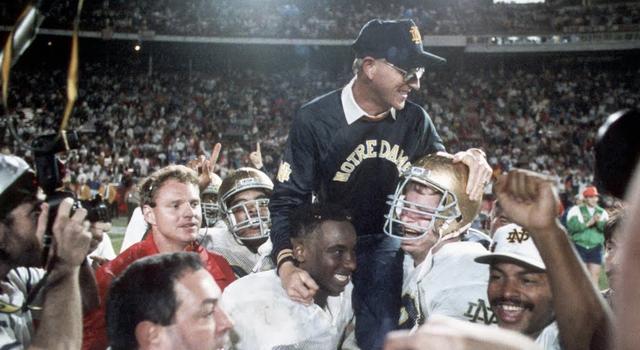
Holtz’s defining moment happened during the unforgettable 1988 season, when Notre Dame went 12–0 and captured the national championship — a title that still remains as the program’s most recent.
The season included multiple iconic moments, none bigger than Notre Dame’s dramatic victory over Miami in the legendary “Catholics vs. Convicts” showdown. The Irish defeated the defending national champion Hurricanes in one of the most intense and memorable games in college football history.
Notre Dame would go on to defeat USC and West Virginia in the Fiesta Bowl to secure the national title.
The championship cemented Holtz’s place among the greatest coaches in Notre Dame history.
But it was far from the only moment that defined his tenure in South Bend.
Iconic Moments Which Defined the Holtz Era
Holtz’s decade in South Bend produced countless indelible moments that still strike a chord with Irish fans today.
One of the most famous came in the 1992 Sugar Bowl against Florida, when Holtz famously used an insult from a waiter – who said the difference between Notre Dame and Cheerios was that “Cheerios belong in a bowl” – as motivation for his team. The Irish responded with a dominant 39–28 victory over the Gators in what became known as the “Cheerios Bowl”.
Another legendary game came the following year when No. 1 Florida State visited No. 2 Notre Dame in 1993, a matchup widely dubbed the “Game of the Century.” The Irish prevailed 31–24 in a thriller that lived up to its enormous hype and briefly propelled Notre Dame to the top of the national rankings.
Holtz also delivered one of the most dramatic wins of the era in the 1992 Snow Bowl against Penn State. Played in brutal weather conditions, Notre Dame stunned Joe Paterno’s Nittany Lions 17–16 after scoring late and converting a decisive two-point conversion.
And of course, there were the uniquely “Lou Holtz” moments that captured his fiery winning spirit. One of the most entertaining came amid a heated 1992 matchup with BYU when Holtz briefly put referee Tom Thomert in a headlock on the sideline — a moment that has lived on in Notre Dame lore.
Together, those games helped define a period during which Notre Dame football was once again must-watch television.
Developing Leaders and Stars
Holtz’s success was driven by the players he developed and the culture he created inside the program.
His teams featured some of the most memorable players in modern Notre Dame history, including quarterback Tony Rice, electrifying playmaker Raghib “Rocket” Ismail, Hall of Fame running back Jerome Bettis, quarterback Rick Mirer, and defensive standout Chris Zorich.
Holtz demanded excellence both on and off the field. Academic achievement and personal development were emphasized alongside football development, and many former players have credited Holtz with developing the leadership skills that guided them long after their playing careers ended.
That emphasis on developing complete student-athletes remains one of the defining pillars of Notre Dame football.
A Mentor for the Next Generation – Including Marcus Freeman
Holtz’s influence did not end when he stepped away from coaching. In fact, his connection to the program continued into the modern era – including with current head coach Marcus Freeman.
Early in Freeman’s tenure at Notre Dame, Holtz served as a sounding board and mentor as the young coach managed the enormous responsibility of leading one of college football’s most storied programs.
Their relationship was prominently featured in the 2024 Peacock documentary series Here Come the Irish, which showed Freeman visiting with Holtz and seeking his perspective on leadership, culture, and what it means to represent Notre Dame.
Those interactions offered a striking reminder that the program’s past and present are deeply connected.
Freeman frequently talks about the importance of culture, accountability, and developing players into leaders — principles that were central to Holtz’s teams in the late 1980s and early 1990s.
In many ways, the standard Holtz restored is the same one Freeman continues to chase today.
The Legacy That Will Never Fade
Lou Holtz will forever stand among the giants of Notre Dame football.
He restored the program’s swagger.
He delivered a national championship.
He shaped generations of players and fans.
But perhaps most importantly, he reminded the college football world what Notre Dame football could be at a time when people question whether or not it could ever reach its past prominence.
Holtz once famously said, “Remember, we’re Notre Dame and they ain’t!”
For more than a decade in South Bend, those words defined the Fighting Irish.
And even today, long after his final game on the Notre Dame sideline, the standard Lou Holtz set still shapes the expectations of Notre Dame football.