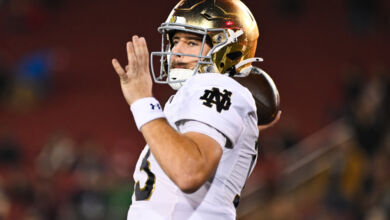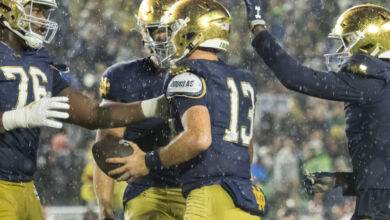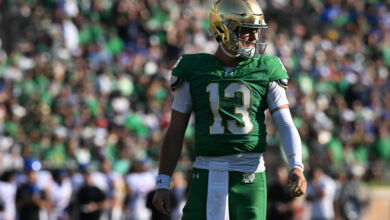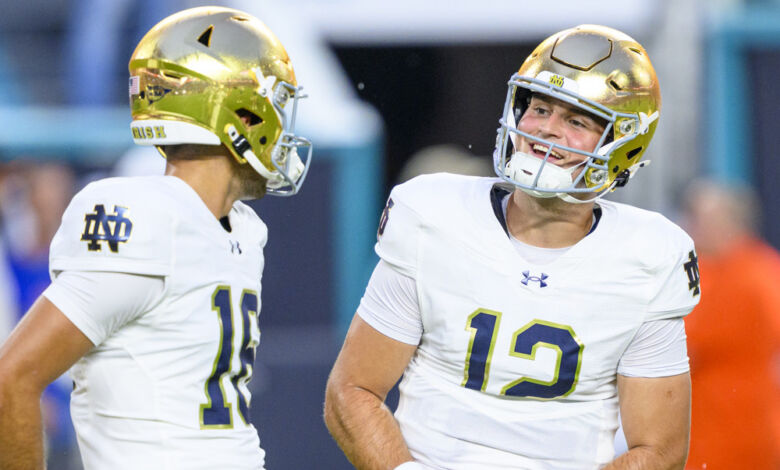
There’s no mystery at the top of Notre Dame’s quarterback depth chart heading into spring. CJ Carr is firmly entrenched as QB1 and a potential Heisman front-runner. Behind Carr, though, one of the biggest question marks of the spring is who will serve as Carr’s backup this season and who will have a leg up on the next quarterback competition at Notre Dame, assuming Carr’s continued ascendence leads him to the NFL Draft next spring.
“Obviously, CJ will get the reps with the ones,” Marcus Freeman said. That part of the equation is settled as spring starts for the first time during the Freeman era. Unlike past seasons, where the focus centered on naming a starter, this spring is about something more layered: defining immediate roles while continuing to develop the long-term future of the position.
Carr leads, but the real evaluation starts behind him
With Carr taking the bulk of the reps, the real challenge for Notre Dame’s staff is how to properly evaluate the rest of the room — specifically Blake Hebert and Noah Grubbs — in a limited number of practice opportunities.
Quarterback is unique in that reps can’t be evenly divided across the depth chart. Freeman acknowledged that reality and emphasized that the evaluation this spring will depend heavily on how practice is structured.
“We have to be intentional about where we can script drills or periods where we have a third group and where we can only have two groups,” Freeman said.
The word intentional came up repeatedly. It’s not just about getting Hebert and Grubbs on the field. It’s about putting them in situations where the staff can truly evaluate how they operate the offense, make decisions, and respond to live competition. With Carr himself still needing to develop as the starter, every rep behind him becomes more valuable — and harder to come by.
That evaluation now includes an experienced wildcard in Tyler Buchner, who has moved back to quarterback this spring. While Buchner is not viewed as the long-term answer at the position, he immediately brings something no one else in the room behind Carr has – meaningful game experience.
That experience could prove significant in the short-term portion of this competition. If neither Hebert nor Grubbs separates themselves, Buchner provides a proven option who understands the offense, has played in big moments, and could be trusted to step in if needed. His presence adds a different dynamic to the battle, particularly when it comes to identifying a reliable No. 2.
A competition with two different timelines
One of the more revealing aspects of Freeman’s comments was how he framed the competition itself. This isn’t simply a battle to determine who the No. 2 quarterback will be when Notre Dame opens the season.
It’s also the beginning of a longer process to identify the program’s next starting quarterback. Those two timelines, while related, are not necessarily the same.
“At some point before the season starts, you have to name a backup quarterback, because that guy at any moment can be the starter,” Freeman said.
That’s the short-term priority. Notre Dame needs a quarterback who can step in immediately and operate the offense without hesitation if something happens to Carr.
But Freeman made it clear that the long-term competition will extend much further.
“The competition for who’s going to be the starting quarterback next year is going to go all the way until there is no doubt who that person is,” Freeman said, openly acknowledging that he does not expect to have his starting quarterback back in 2027.
That distinction is important. It allows Notre Dame to prioritize reliability and readiness when selecting a backup — someone like Buchner could factor in — while still giving younger players time to develop into potential future starters without forcing a premature decision.
Teddy Jarrard’s arrival adds another layer
The quarterback picture will evolve again this summer when Teddy Jarrard arrives on campus. While incoming freshman Teddy Jarrard won’t participate in spring practice, Freeman made it clear that his timeline doesn’t exclude him from competing once he gets to South Bend.
“At the end of the day, you’ll let him compete. You’ll let him compete,” Freeman said.
That approach reflects how Notre Dame is structuring the room overall. Carr may be the established starter, but beyond that, the depth chart is still being shaped. Jarrard will enter a competition that has already begun, but one that is far from settled.
His addition also reinforces that this is not a one-phase evaluation. What happens this spring is only part of the process. Fall camp, with Jarrard in the mix, will be just as critical in determining how the depth chart ultimately shakes out.
Spring is about clarity, not final answers
For all the attention that will be placed on the backup quarterback competition over the next several weeks, Freeman made it clear that spring is about gathering information, not locking in long-term decisions.
“It’s about how you’re intentional with scripting practice to get the right amount of looks or reps to evaluate the guys that are in competition,” Freeman said.
That evaluation is especially important given how young the room behind Carr is. Hebert and Grubbs will be asked to handle increased responsibility this spring, not just in terms of reps, but in showing command of the offense, consistency, and the ability to execute under pressure.
At the same time, the staff has to balance that evaluation with Carr’s continued development. As the starting quarterback, he still needs the majority of meaningful reps, which naturally limits the others’ exposure. That makes the structure of practice — and the ability to maximize limited opportunities — even more important.
The urgency of finding a reliable No. 2
While the long-term competition may extend into the future, one decision must be made before the season begins: who is the backup quarterback?
“The backup quarterback, at any moment, can be the starter. So that guy has to know, prepare, and take all the two reps in practice.”
That responsibility carries significant weight, especially for a team with high expectations. The No. 2 quarterback isn’t just a developmental piece — he’s one snap away from being thrust into a critical situation.
That urgency adds another layer to what the staff is evaluating this spring. It’s not just about upside or long-term potential. It’s about trust — who can operate the offense, who can handle pressure, and who the staff believes can step in without hesitation if needed.
And in that specific aspect of the competition, experience could matter just as much as upside.
What to watch as spring unfolds
As Notre Dame opens spring practice, the headline won’t be about who the starting quarterback is. That part is already established.
Instead, the most important developments will come from how the competition behind Carr takes shape. How reps are distributed, how Hebert and Grubbs perform with limited opportunities, how Buchner factors into the mix, and how much separation — if any — begins to emerge.
Jarrard’s arrival this summer will add another layer to the equation, but the foundation of the competition starts now.
By the end of spring, Notre Dame may not have all the answers.
But it should have a much clearer picture of where its quarterback room stands behind CJ Carr — and which players are positioning themselves to be the next man up.