
Jeremiyah Love: A Model of Notre Dame’s Standards for Success
Jeremiyah Love exemplifies the discipline and ambition that Notre Dame seeks in its players.

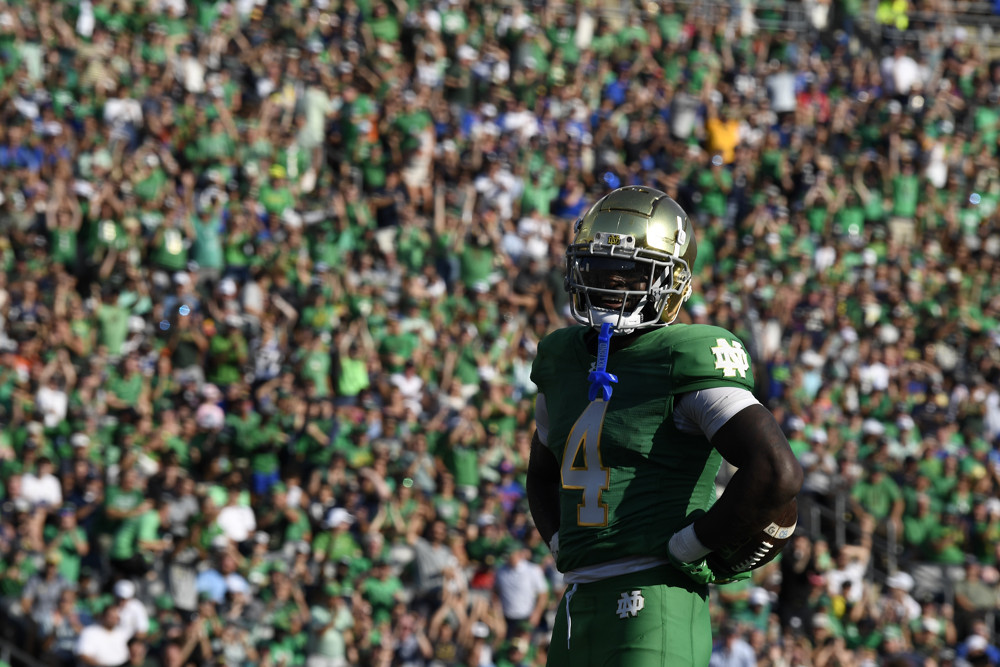
The easy headline out of Jeremiyah Love’s comments is the Hall of Fame line. It is big, bold, and built to travel. But the more important Notre Dame takeaway is not that Love dreams big. It is that he sounds exactly like the kind of player Marcus Freeman has spent the last few years insisting this program should produce.
That distinction matters. Plenty of elite prospects talk about greatness. Plenty of future draft picks say they are never satisfied. What separates Love here is how naturally his ambition came packaged with discipline, detail, accountability, and development. That is not random. That is not branding fluff. That is a Notre Dame coaching point showing up in the voice of one of the program’s best players.
Love’s Ambition and Drive
Love put the ambition out front when he said, “What I meant when I said I’m on the hunt for something greater is I wanted to convey that I’m not complacent. I’m not satisfied from just getting here. I want to be a Hall of Famer by the end of my time playing. I want to be one of the greatest running backs to come through the game.”
That is the quote people will grab, and they should. Notre Dame needs stars who think like stars. It needs players who arrive in South Bend expecting more than a nice college career and a shot at the league. The program has had enough good players. The next step is producing more players whose internal standard matches the external messaging Freeman has been selling since he took over.
Family Influence and Coaching Standards
The key is that Love did not frame that ambition like empty self-promotion. He framed it like work.
He tied it to the voice of his parents. He tied it to the standards of Deland McCullough. He tied it to Freeman’s message. That is the revealing part.
Love made the family foundation clear when he said, “My parents, being police officers, they’re army veterans as well. So, you can only imagine what that household was like… they instilled principles of discipline in me.”
That background matters because it shows why the messaging lands. Freeman’s program is built on demanding habits, not just hype videos and slogans. For that model to work, the best players have to absorb it and own it. Love sounds like someone who has.
Internalized Culture and Development
He made that connection explicit: “My mom and dad told me to never be complacent, never be satisfied. Coach Freeman always says, choose hard and consistently find ways to get better.”
There it is. That is the real story.
Freeman has talked endlessly about standards, process, and hard choices. Sometimes coaches say those things and you never really hear them reflected back by the players in a meaningful way. With Love, you do. His language does not feel borrowed for an interview. It feels internalized. That is a huge difference for a program trying to prove its culture talk is more than a recruiting pitch.
And it is not just abstract motivation, either. Love immediately connected greatness to technical development. He said, “My running backs coach, Deland McCullough, shoot, right from the bat, told me the importance of ball security. And I kid you not, in literally the stretch lines, my very first stretch line, he gave me like this beeper ball and I had to hold it throughout the whole stretch.”
Focus on Fundamentals
That is not glamorous. It is not NIL talk. It is not draft stock talk. It is the boring, relentless stuff that actually turns elite traits into elite production.
Love drove the point home: “So, ball security is everything. The ball is the game. Without the ball, you can’t win games.”
That is exactly how a developed running back should talk. Not just explosive plays. Not just yards. Not just personal goals. The job first. The detail first. The trust first.
McCullough’s room has been one of the clearest examples of Notre Dame’s player-development model working under Freeman. Audric Estime became a tone-setting back. Jadarian Price fought back from injury and became a real weapon. Love arrived with blue-chip talent, but talent alone does not get a player to this level of command over his role. The coach’s standard has to take hold. In this case, it clearly has.
The Bigger Picture
That is why the Hall of Fame line should not be dismissed as young-player bravado. It should be seen as a sign that Notre Dame is getting more of the right kind of confidence from its top-end talent. Love is not talking like someone impressed with having made it this far. He is talking like someone irritated by the idea of stopping here.
He said it flatly: “I wanted to go back to school and get my degree. I wanted to become a doctor before I played football. So, throughout life, I’m always going to be on the hunt for something greater.”
Again, the point is not just that Love aims high. It is that his ambition is expansive without becoming self-indulgent. He talks like a player who sees football as one standard inside a larger life of discipline and achievement. Notre Dame should want more of that, especially from its best players. The program has always sold the total package. The challenge has been proving that elite football development can thrive inside it. Love sounds like evidence that it can.
He also understands the position in team terms, which is another marker of mature development. Love said, “A running back is supposed to make the defense rest longer and it’s supposed to make the offense score touchdowns. Obviously, block and allow guys like Marv to run those deep balls.”
That answer is revealing in its own way. He is a star back talking about pass protection, clock control, and setting up teammates. That is not accidental. That is coaching. That is role clarity. That is a player whose talent has been sharpened by a defined standard instead of being allowed to freelance on reputation.
For Notre Dame, that is the larger bet under Freeman. Not just recruit better players. Not just develop them enough to get drafted. Develop them into the kind of leaders who leave the program sounding like they have been shaped by it. Love does.
And if Notre Dame is going to break through where this era still has not, that cannot be limited to one running back room or one especially driven player. It has to become normal. The next step for Freeman’s program is making sure Jeremiyah Love is not the exception people point to, but the blueprint people recognize across the roster.


Frank Vitovitch has been Co-Owner and Editor in Chief of UHND.com since joining forces with Kyle Flavin in 1999. Since that time, he has written over 2,000 articles covering Notre Dame football, recruiting, and basketball. He also works with all staff and external writers on all articles published on UHND.com. Frank's love for Notre Dame football started at a young age watching Rocket Ismail give opposing coaches ulcers in the late 1980's. By day Frank works in marketing and holds a degree in Digital Media from Drexel University. Frank's work has been cited by online/print editions of NBC Sports, ESPN, and Sports Illustrated and has been quoted on air by ESPN's Collin Cowherd. He's conducted interviews with Notre Dame legends Rocket Ismail, Randy Kinder, Lee Becton, Reggie Brooks, Michael Stonebreaker, and Ned Bolcar among others over his 20+ years of covering Notre Dame football. He's also been published in the print edition of USA Today Sports Weekly and the USA Today College Football Preview multiple times. Other Published Works/Citations for Frank Three Reasons Notre Dame Will Beat Alabama - USA Today Notre Dame Suspends WR Kevin Stepherson, RB C.J. Holmes Indefinitely - Bleacher Report Notre Dame / Ohio State Fiesta Bowl Preview - Eleven Warriors Brace Yourself: The Fighting Irish are Relevant Again - Sports on Earth Interviews with the Enemy: A Q&A with Frank Vitovitch of UHND - Yahoo! Sports Five Good Minutes: Notre Dame Football Preview With UHND.com - BC Interruption Vicious Electronic Questioning with UHND - MGO Blog
Comments
BE FIRST TO RESPOND