
Arizona Bets Big on Jeremiyah Love, and Notre Dame’s Star Earned Every Bit of It

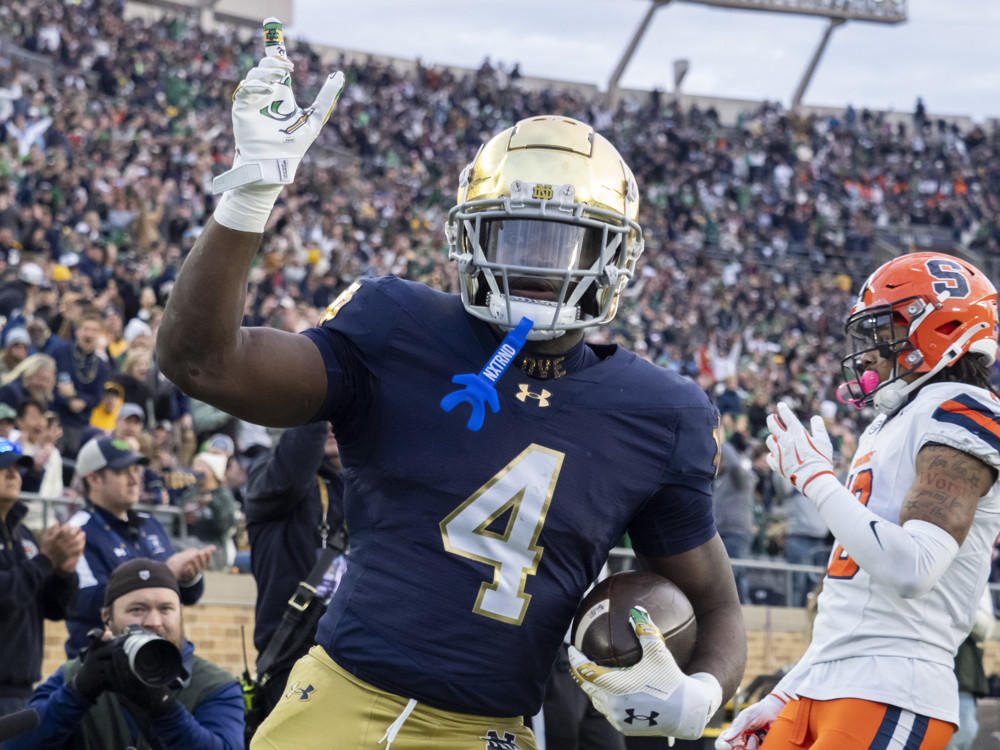
Arizona selected Jermeiyah Love with the No. 3 overall pick Thursday night, making the Notre Dame star one of the highest-drafted Irish skill players in modern NFL history and putting him immediately at the center of the Cardinals’ offensive rebuild. That is a massive bet on a running back. It is also a bet on one of the few players in this draft who can actually change the geometry of an NFL offense from day one.
The easy version of this pick is that the Arizona Cardinals just took a running back too high. That will be the default reaction in a league that has spent most of the last decade trying to convince itself that the position is interchangeable, replaceable, and rarely worth premium draft capital. In most cases, that reaction is right.
Jeremiyah Love is not most cases.
Notre Dame has had productive backs before. Kyren Williams was a complete college back who became better in the NFL than plenty of evaluators expected. Josh Adams had a brilliant 2017 run behind Quenton Nelson and Mike McGlinchey. Audric Estime gave the Irish a physical identity when the offense needed one. Love is different because he paired that Notre Dame toughness with top-shelf explosiveness.
That combination is why he went this high.
Love’s final season in South Bend was not just good. It was the kind of year that forces NFL front offices to reconsider their positional rules. He rushed for 1,372 yards and 18 touchdowns on 199 carries, averaging 6.9 yards per attempt. He added 27 receptions for 280 yards and three more scores. That gave him 1,652 yards from scrimmage and a Notre Dame single-season record 21 total touchdowns.
Those numbers matter because they were not empty production. Love was the focal point of the Irish offense, the player every defense had to find before the snap, and he still kept hitting explosives. He finished the season with six 100-yard rushing games and a 94-yard touchdown run against Boston College, making him the first Irish player with two career runs of at least 90 yards.
The Cardinals are not drafting Love to be a nice piece next to James Conner, Tyler Allgeier, and Trey Benson. You do not use the third pick in the draft on a committee back. Arizona is drafting Love to become the offensive identity under Mike LaFleur, and that part of the fit makes sense. LaFleur now has a back who can run inside zone, bounce outside, motion into empty, punish linebackers in coverage, and turn a routine second-and-6 into a 60-yard problem.
That is what Love was for Notre Dame. That is what Arizona needs him to be.
The uncomfortable part is that Arizona still has other needs. A team picking third overall is not usually one running back away from anything, and the Cardinals could have used help on the edge, in the secondary, or along the offensive line. There is a reason teams usually talk themselves out of this type of pick.
But this is where the evaluation has to be honest. If Love is merely a good NFL running back, this pick will be criticized. It should be. At No. 3 overall, “good” is not enough. The Cardinals are drafting him to be a force multiplier, the kind of player who makes the quarterback cleaner, the line look better, the passing game easier, and every defensive coordinator a little less comfortable.
That is the standard now.
For Notre Dame, this is also a significant statement. The Irish have sent plenty of offensive linemen, tight ends, and defensive players into the league under Brian Kelly and Marcus Freeman. Skill-position stardom has been more complicated. Love breaking through this way matters because Notre Dame is not supposed to be just a developmental program for guards, tackles, and tight ends. It should be able to recruit, develop, and feature elite offensive playmakers too.
Love proved that.
He was not a product of a gimmick offense. He was not hidden in space. He ran through contact, created explosives, caught the ball, finished drives, and became the player Notre Dame leaned on when the season demanded it. That is why NFL Network’s Daniel Jeremiah described him before the draft as a complete back and pointed to his passing-game value as one of the traits that separated him from a normal first-round runner.
Love said it plainly before the draft: “I’m a complete player. I’m a team player.”
Arizona clearly believed him.
Draft Grade: A-
The only thing keeping this from an A is positional value. That is not a small thing. Taking a running back third overall is a luxury move for a team that still has plenty of non-luxury problems.
But the player is worth the swing.
Love gives Arizona a legitimate offensive centerpiece and gives Notre Dame another proof point that the program can produce more than rugged, reliable, Sunday-ready players. It can produce stars. If the Cardinals build the offense around what Love actually does well instead of treating him like a traditional volume back, this pick can look aggressive instead of reckless.


Frank Vitovitch has been Co-Owner and Editor in Chief of UHND.com since joining forces with Kyle Flavin in 1999. Since that time, he has written over 2,000 articles covering Notre Dame football, recruiting, and basketball. He also works with all staff and external writers on all articles published on UHND.com. Frank's love for Notre Dame football started at a young age watching Rocket Ismail give opposing coaches ulcers in the late 1980's. By day Frank works in marketing and holds a degree in Digital Media from Drexel University. Frank's work has been cited by online/print editions of NBC Sports, ESPN, and Sports Illustrated and has been quoted on air by ESPN's Collin Cowherd. He's conducted interviews with Notre Dame legends Rocket Ismail, Randy Kinder, Lee Becton, Reggie Brooks, Michael Stonebreaker, and Ned Bolcar among others over his 20+ years of covering Notre Dame football. He's also been published in the print edition of USA Today Sports Weekly and the USA Today College Football Preview multiple times. Other Published Works/Citations for Frank Three Reasons Notre Dame Will Beat Alabama - USA Today Notre Dame Suspends WR Kevin Stepherson, RB C.J. Holmes Indefinitely - Bleacher Report Notre Dame / Ohio State Fiesta Bowl Preview - Eleven Warriors Brace Yourself: The Fighting Irish are Relevant Again - Sports on Earth Interviews with the Enemy: A Q&A with Frank Vitovitch of UHND - Yahoo! Sports Five Good Minutes: Notre Dame Football Preview With UHND.com - BC Interruption Vicious Electronic Questioning with UHND - MGO Blog
Comments
BE FIRST TO RESPOND