CJ Carr’s Growth Signals New Era for Notre Dame Offense
Exploring how C.J. Carr's growth signals a transformative shift in Notre Dame's offensive strategy.

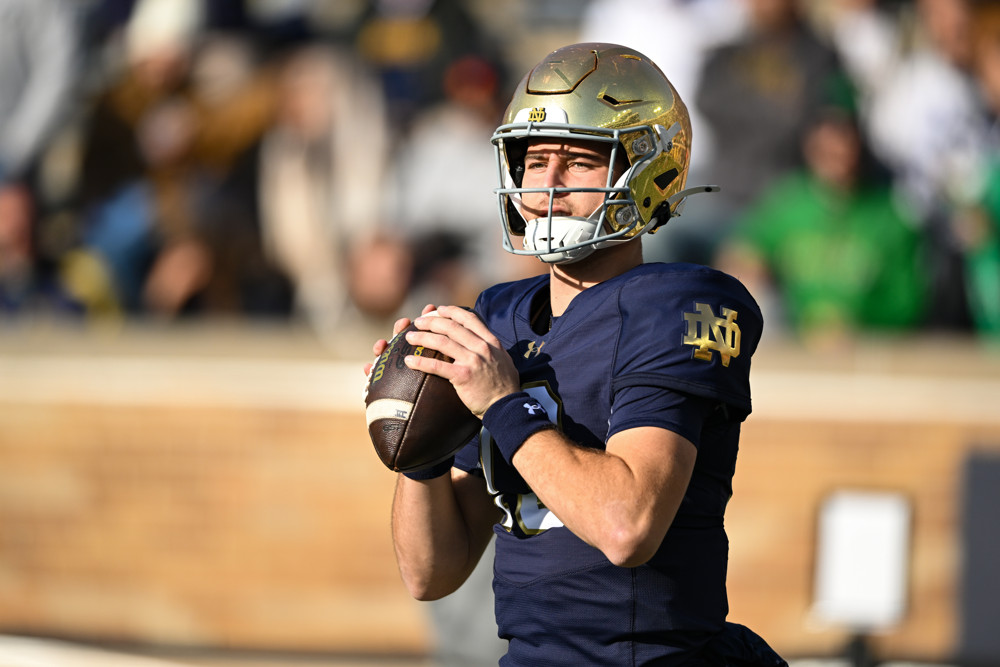
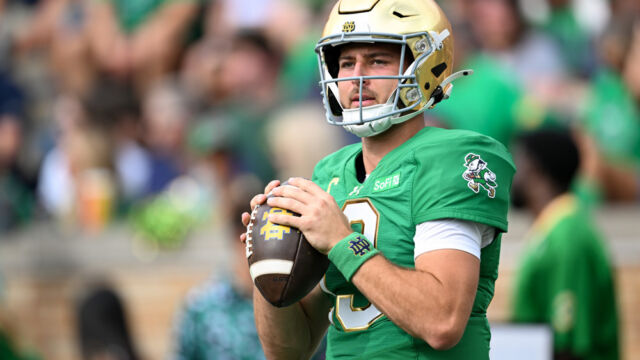
The easy way to talk about C.J. Carr is to start with talent: big arm, natural thrower, former blue-chip recruit, all of that. But Marcus Freeman’s most revealing recent praise of Carr had nothing to do with velocity or highlight reel throws. It was about control. It was about whether Notre Dame finally has a quarterback who can keep a play from dying before everyone else even realizes it is in trouble.
That is the difference between a quarterback who runs the offense and one who owns it. And when Freeman says Carr is showing that kind of command, he is saying something much bigger than, “This kid looks good in practice.”
Freeman put it plainly: “You don’t have to have a coach tell you everything. He’s able to understand a play. He’s able to see what the defense is doing and put us in a position that usually ends up in a positive play. And so that’s invaluable to have a true problem solver.”
That is not empty camp-season quarterback talk. Coaches hand out arm-talent compliments like candy in August. They do not casually call a young quarterback a “true problem solver” unless they believe he is processing the game at a level that changes what the offense can be.
The Importance of Command Over Talent
Why this matters more than arm talent? Notre Dame does not need its quarterback to be a seven-on-seven star. It needs one who can diagnose leverage, identify pressure, clean up a bad call, and get the offense into an answer before the snap or within the structure of the play. That is where Mike Denbrock’s offense expands. The playbook always looks better when the quarterback is not trapped inside it.
Freeman connected Carr’s growth directly to that kind of operational command when he said, “That’s again accumulation of his preparation, but with coach Denbrock being back, coach Guidugli being back, CJ Carr being back the experience is what helps that more than anything else.”
That line matters because it points to something Notre Dame has not had enough of at quarterback in recent years: continuity leading to autonomy. The more a quarterback knows the system, the less he has to be dragged through it. He stops being a repeater of coaching points and starts becoming the player who solves problems the coaches cannot solve in real time once the ball is snapped.
Transforming the Offense
That is where ceilings change. A physically gifted quarterback can make the hard throw. A prepared quarterback who sees it early can make the easy one and keep the offense on schedule. Notre Dame has had stretches where too much of the passing game felt pre-scripted, too dependent on perfect structure, and too vulnerable once the defense disrupted the first read. A quarterback who can “see what the defense is doing and put us in a position” to get the right answer erases some of that fragility.
And that is why Freeman’s comment should land harder than any generic praise about accuracy or leadership.
The Ripple Effect of Carr’s Command
This is not just about Carr in isolation. If Notre Dame trusts him to solve problems, then everyone around him benefits. Protection calls get cleaner. Hot answers come faster. Receivers play with more confidence because the ball is getting where it should go. And Denbrock can call offense more aggressively because he knows the quarterback is not a passenger.
Freeman’s broader comments about where the offense is in camp fit that picture too. “Like today’s an evaluation day. That’s what I told them. We have to evaluate our coaching. We have to evaluate the way our players have received our coaching and prepared.”
That is what this stage is really about: not just whether Carr can spin it, but whether the staff can trust him with more of the operation. Freeman’s comments strongly suggest that answer is trending in the right direction.
The infrastructure around him matters too. Freeman said, “I think the entire offensive line as a whole, that first group has done a really good job of jelling together, right?”
That is not a throwaway line when talking about a quarterback learning to control the offense. Quarterback autonomy only becomes dangerous, in a good way, when the line is stable enough to let those answers play out. If Notre Dame gets that combination—a quarterback who can solve the picture and an offensive line that can hold it together—then Denbrock’s system gets a lot more difficult to defend.
And that is the real takeaway here. Freeman was not complimenting Carr for looking the part. He was describing a quarterback beginning to think the position the way Notre Dame needs it to be played. If that continues into the season, Carr will not just be executing the offense. He will be elevating it.

Frank Vitovitch has been Co-Owner and Editor in Chief of UHND.com since joining forces with Kyle Flavin in 1999. Since that time, he has written over 2,000 articles covering Notre Dame football, recruiting, and basketball. He also works with all staff and external writers on all articles published on UHND.com. Frank's love for Notre Dame football started at a young age watching Rocket Ismail give opposing coaches ulcers in the late 1980's. By day Frank works in marketing and holds a degree in Digital Media from Drexel University. Frank's work has been cited by online/print editions of NBC Sports, ESPN, and Sports Illustrated and has been quoted on air by ESPN's Collin Cowherd. He's conducted interviews with Notre Dame legends Rocket Ismail, Randy Kinder, Lee Becton, Reggie Brooks, Michael Stonebreaker, and Ned Bolcar among others over his 20+ years of covering Notre Dame football. He's also been published in the print edition of USA Today Sports Weekly and the USA Today College Football Preview multiple times. Other Published Works/Citations for Frank Three Reasons Notre Dame Will Beat Alabama - USA Today Notre Dame Suspends WR Kevin Stepherson, RB C.J. Holmes Indefinitely - Bleacher Report Notre Dame / Ohio State Fiesta Bowl Preview - Eleven Warriors Brace Yourself: The Fighting Irish are Relevant Again - Sports on Earth Interviews with the Enemy: A Q&A with Frank Vitovitch of UHND - Yahoo! Sports Five Good Minutes: Notre Dame Football Preview With UHND.com - BC Interruption Vicious Electronic Questioning with UHND - MGO Blog
Comments
BE FIRST TO RESPOND