
Jadarian Price Lands in Seattle With a Real Path to Immediate Impact

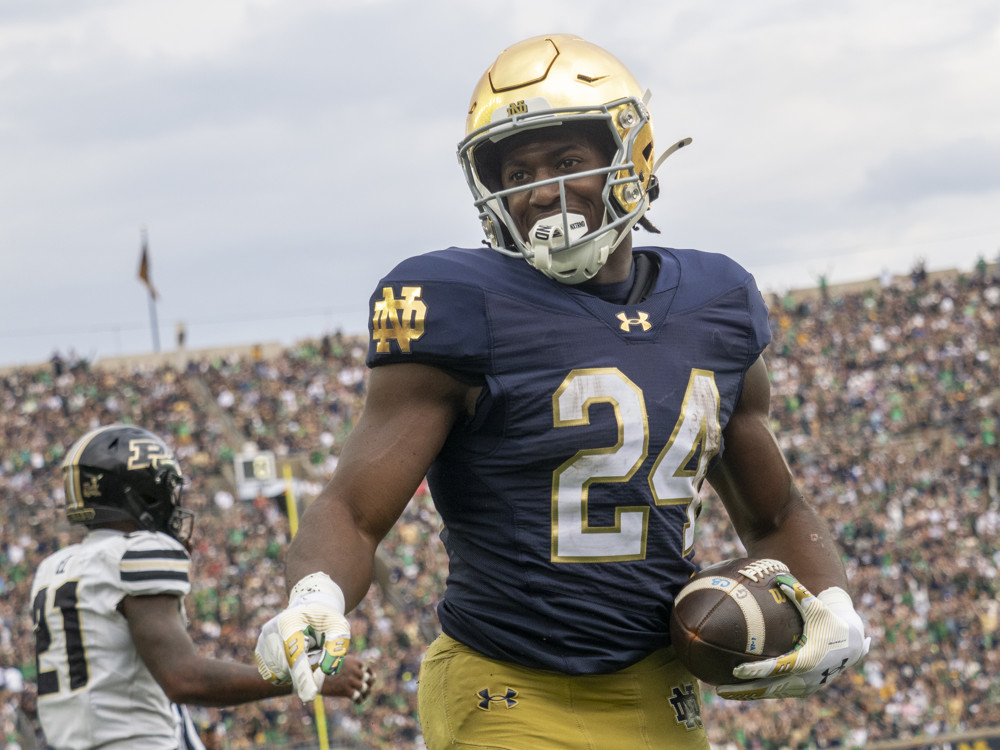
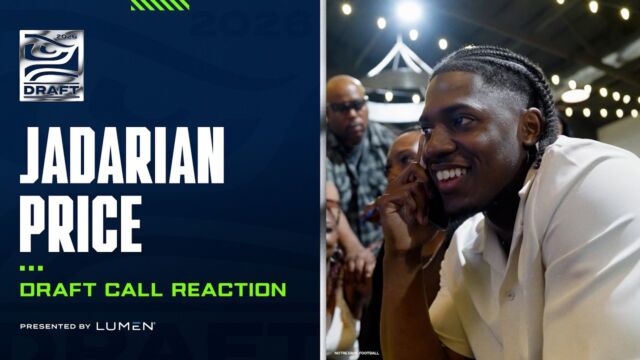
The Seahawks selected Notre Dame running back Jadarian Price with the final pick of the first round, giving Notre Dame two first-round running backs and giving Seattle a direct answer to the biggest offensive question it created for itself this offseason.
Kenneth Walker III helped carry the Seahawks to a Super Bowl LX win, rushing for 135 yards on 27 carries against New England and becoming the first running back since Terrell Davis to win Super Bowl MVP. Then Seattle let him walk, with Walker agreeing to a three-year, $43.05 million deal with Kansas City. That is not a minor roster loss. That is the identity of a championship offense leaving the building.
The Seahawks’ pre-draft needs profile in the prospect file centered on interior offensive line, defensive tackle, and tight end, but the loss of Walker makes the selection of Price make a lot of sense. Losing a Super Bowl MVP running back changes the math entirely. Once Walker was gone, Seattle needed more than a warm body behind Zach Charbonnet. It needed speed, return value, and another back capable of stressing defenses without requiring 22 touches to matter.
Price checks those boxes.
His final Notre Dame season was not built on volume. It was built on efficiency and volatility, and in this case volatility is a compliment. Price ran for 674 yards and 11 touchdowns on 113 carries, averaging 6.0 yards per attempt. He added 87 receiving yards and two receiving touchdowns, but the real separator was special teams, where he became one of the most dangerous return men in the country, earning first-team All-American kick returner with elite speed and versatility. That is part of why he can justify sneaking into the back end of the first round.
Notre Dame fans already know the play that crystallized it. Against USC, Price ripped off a tackle-breaking 100-yard kickoff return in a 34-24 Irish win, the kind of play that does not just flip field position but changes the emotional temperature of a rivalry game. He also finished his Irish career with three kickoff-return touchdowns, an had 794 kickoff return yards on 22 returns, a ridiculous 37.5-yard average.
That matters in Seattle because this is not a team drafting a traditional RB2. If the Seahawks wanted only a between-the-tackles replacement, they could have waited. Price gives them more than that. He gives them a back who can pair with Charbonnet, handle return duties immediately, and create explosive plays without Seattle having to force-feed him into Walker’s exact role.
That is important because Walker was not just productive. He was decisive. In the Super Bowl, Seattle’s offense was not exactly a machine. Sam Darnold threw one touchdown, Jason Myers kicked five field goals, and the defense did a lot of the heavy lifting. Walker’s 135 yards were the difference between a gritty win and an offense that might have stalled out entirely.
Replacing him won’t be easy, but Price is used to playing behind someone who casts a big shadow.
He has enough burst to punish light boxes, enough contact balance to survive inside work, and enough special-teams value to dress and contribute immediately, even if the offensive role develops gradually. Price can help Seattle in multiple phases right away.
There is also a Notre Dame angle here that should not get lost behind Love’s top-three moment. Price could have been treated as a luxury piece in South Bend, especially after missing his first season with an Achilles injury. Instead, he became a legitimate weapon in Marcus Freeman’s offense and one of the most dangerous kick returners Notre Dame has had in years.
Draft Grade: B+
The value is not perfect, but the fit is real. Seattle lost the running back who just delivered the defining performance of its championship season, and it answered with one of the most explosive players Notre Dame had. If Price turns his efficiency into a sustainable NFL role instead of just a highlight reel, the Seahawks did not draft a replacement for Kenneth Walker. They drafted the first piece of their next offensive identity.

Frank Vitovitch has been Co-Owner and Editor in Chief of UHND.com since joining forces with Kyle Flavin in 1999. Since that time, he has written over 2,000 articles covering Notre Dame football, recruiting, and basketball. He also works with all staff and external writers on all articles published on UHND.com. Frank's love for Notre Dame football started at a young age watching Rocket Ismail give opposing coaches ulcers in the late 1980's. By day Frank works in marketing and holds a degree in Digital Media from Drexel University. Frank's work has been cited by online/print editions of NBC Sports, ESPN, and Sports Illustrated and has been quoted on air by ESPN's Collin Cowherd. He's conducted interviews with Notre Dame legends Rocket Ismail, Randy Kinder, Lee Becton, Reggie Brooks, Michael Stonebreaker, and Ned Bolcar among others over his 20+ years of covering Notre Dame football. He's also been published in the print edition of USA Today Sports Weekly and the USA Today College Football Preview multiple times. Other Published Works/Citations for Frank Three Reasons Notre Dame Will Beat Alabama - USA Today Notre Dame Suspends WR Kevin Stepherson, RB C.J. Holmes Indefinitely - Bleacher Report Notre Dame / Ohio State Fiesta Bowl Preview - Eleven Warriors Brace Yourself: The Fighting Irish are Relevant Again - Sports on Earth Interviews with the Enemy: A Q&A with Frank Vitovitch of UHND - Yahoo! Sports Five Good Minutes: Notre Dame Football Preview With UHND.com - BC Interruption Vicious Electronic Questioning with UHND - MGO Blog
Comments
BE FIRST TO RESPOND