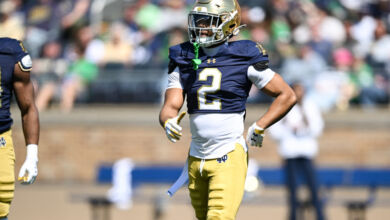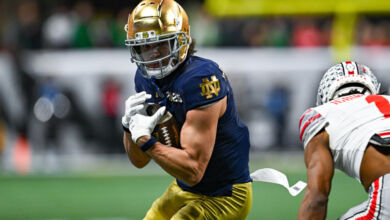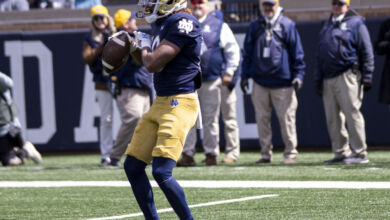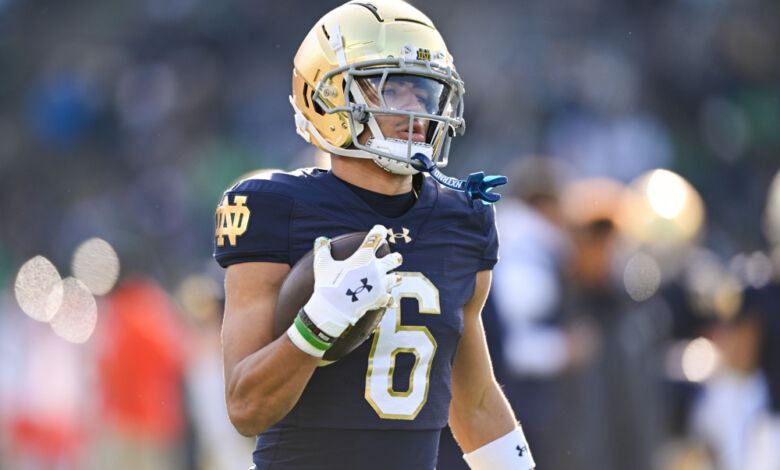
Notre Dame enters the 2026 season with one of its deepest and most intriguing wide receiver rooms of the Marcus Freeman era. After leaning heavily on transfers and role players in recent years, the Irish now have a mix of proven production, high-end portal talent, and a strong developmental pipeline behind it. With CJ Carr entering year two under Mike Denbrock, expectations for the passing game are higher than they’ve been in quite some time, and the receiver room will be central to whether those expectations are met.
There are established answers at the top, real competition for snaps behind them, and very little margin for complacency across the depth chart. From Jordan Faison’s decision to focus solely on football to the arrival of former five-star transfers Quincy Porter and Mylan Graham, this group looks very different than it did a year ago. The question now is not whether Notre Dame has enough bodies at wide receiver, but how the pieces fit together and who ultimately emerges as consistent playmakers.
Below is a look at how the room stacks up heading into spring, starting with the established veterans and working down the depth chart.
| Position | 1st String | 2nd String | 3rd String |
|---|---|---|---|
| Field Receiver | Jordan Faison | Mylan Graham | Cam Williams / Elijah Burress |
| Boundary Receiver | Quincy Porter | Micah Gilbert | Kaydon Finley |
| Slot Receiver | Jaden Greathouse | Logan Saldate | Dylan Faison |
Established Veterans
Jordan Faison
Notre Dame’s leader in receiving yards (640) and receptions (49) returns as the clear headliner in the room and the likely top target in the passing game. To prepare, the star lacrosse player has given up lacrosse to focus solely on football for the first time in his career, a notable decision given how productive he already was while splitting time.
Faison developed a strong rapport with CJ Carr without the benefit of working with him in spring practice a year ago, and that connection should only grow. Mike Denbrock has a history of quarterbacks taking major leaps in year two of his system, and Faison stands to be the biggest beneficiary if that trend holds with Carr.
With the ball in his hands, Faison remains a nightmare in space. With a full spring devoted to football, look for Denbrock to be more creative in how he gets Faison touches, ideally in ways that avoid the static wide receiver screens that became far too familiar a year ago. While there could be some situational slot usage, Faison appears firmly entrenched as the field receiver and the focal point of the room.
Jaden Greathouse
Greathouse appeared primed for a breakout in 2025 after his dominant postseason performances the year prior, including saving Notre Dame against Penn State and nearly single-handedly bringing the Irish back against Ohio State in the national championship game. Unfortunately, injuries once again got in the way.
A lingering hamstring issue limited Greathouse to just four games in 2025, during which he caught four passes for 73 yards. It was a frustrating follow-up to a freshman season in 2023 that was also derailed after a red-hot start. One silver lining of Notre Dame’s postseason omission was the additional time Greathouse, and others, had to get healthy.
If he can stay on the field in 2026, Greathouse is Notre Dame’s most reliable mismatch option inside. He is not a traditional slot receiver given his frame, but as a big slot he could rack up targets, especially with Notre Dame entering the season somewhat inexperienced at tight end.
Returning Depth
Micah Gilbert
The next tier of receivers is defined less by proven production and more by unrealized upside, and Gilbert sits squarely at the top of that group. Injuries again played a role in limiting his impact in 2025, this time a hand injury that restricted him to nine catches for 93 yards and a touchdown.
Gilbert has flashed throughout his career, including standing out during his first spring practice in 2024, but the consistency has yet to follow. Had he been able to carve out a larger role behind Malachai Fields last season, boundary receiver may not have been such a pressing portal need. Instead, Gilbert now enters 2026 in a direct competition with Quincy Porter for snaps on the outside.
Cam Williams
A former five-star recruit, Williams’ career has not unfolded as originally envisioned. He arrived at Notre Dame as a high-upside but raw prospect, and while there have been flashes, he has yet to establish himself in the rotation. To date, he has just one career reception for six yards.
That said, his snap count quietly increased late last season, suggesting the staff may still see something worth developing. Still, 2026 feels like a make-or-break year for Williams to carve out a defined role. He will compete to back up Faison at the field position, but that competition became significantly stiffer with the addition of Mylan Graham.
Elijah Burress
Burress flashed some potential as a true freshman in 2025, primarily in garbage time, and enters his sophomore season firmly in the mix at field receiver. He remains more of a projection than a proven option, but his development this offseason will determine whether he can push for meaningful rotational snaps.
Logan Saldate
One player who could surprise is Saldate. He has one trait that simply cannot be taught: speed. While he caught just one pass for two yards in 2025, Saldate should be firmly in the mix behind Greathouse in the slot.
Retaining a player like Saldate, even without a clear path to immediate snaps, matters for depth and roster stability. Notre Dame lost KK Smith to the portal despite Smith playing far more than Saldate, and keeping speed options in the program has value over the long haul.
Jerome Bettis Jr.
Bettis enters what is likely another developmental year. He only saw action in the Navy blowout and faces a crowded depth chart in front of him. For now, his role remains about long-term growth rather than immediate contribution.
Portal Additions
While internal development is important, Notre Dame clearly wasn’t content standing pat at receiver.
Quincy Porter
One of Notre Dame’s most significant portal additions, Porter is expected to factor into the mix immediately at boundary receiver assuming a full recovery from the injury that sidelined him late in the year. All indications are that he will be ready for fall camp.
A former five-star recruit, Porter fits the physical profile Notre Dame has lacked on the outside and enters the season as the odds-on favorite to start atop the boundary depth chart.
Mylan Graham
Graham followed Porter from Ohio State, but does not have quite as clear a path to a starting role. That said, his speed ensures he will be on the field in 2026 in some capacity.
Notre Dame has rarely leaned on true four-receiver sets, but with the talent available, that could change. Graham may not open the season as a starter, but his ability to stretch the field vertically forces defensive adjustments and gives the offense another dimension.
Incoming Freshmen
It is difficult to envision any true freshman cracking the rotation in 2026 barring injuries, but Notre Dame is bringing in a deep and talented receiver class that strengthens the long-term outlook of the room.
- Devin Fitzgerald – Polished four-star receiver with strong hands and advanced route-running. Projects as an outside target and one of the more college-ready freshmen in the class.
- Kaydon Finley – Long, physical boundary receiver who fits Notre Dame’s preferred outside profile. Developmental four-star with contested-catch upside.
- Dylan Faison – Speedy, versatile receiver capable of playing inside or outside. Long-term slot option with early special teams value.
- Bubba Frazier – Explosive athlete who excels with the ball in space and adds playmaking potential on manufactured touches.
- Brayden Robinson – Elite speed threat who can stretch defenses vertically and stress coverage immediately.
Notre Dame’s wide receiver room looks deeper and more complete heading into 2026 than it did a year ago, particularly after addressing its biggest needs through the transfer portal. There is proven production at the top, legitimate competition throughout the depth chart, and a healthier balance between experience and upside than in recent seasons. How quickly that depth translates into consistency on the field will go a long way toward determining the ceiling of the offense, but for the first time in a while, Notre Dame enters the season with real options and real answers at wide receiver.