
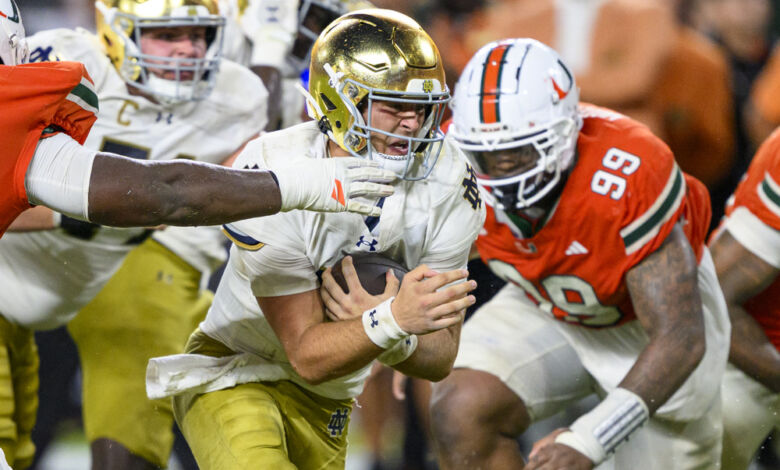
- Notre Dame finished with just 93 rushing yards on 28 attempts (3.3 YPC).
- Jeremiah Love carried only 10 times for 33 yards. Jadarian Price, despite a 30-yard burst and 7.5 YPC, had just six carries.
- CJ Carr went 19-of-30 for 221 yards, 2 TDs, 1 INT, but was sacked three times and lost 24 yards.
- The Irish punted 4 times and went only 4-for-9 on third downs, holding the ball for just 26 minutes compared to Miami’s 34.
- Freeman insisted the early RPO-heavy plan was designed to give Carr “easy throws and easy decisions.”
- The halftime adjustment to feed Love more came too late to tilt the game.
Notre Dame’s season opener in Miami ended in a 27–24 loss that was as much about what the Irish didn’t do on offense as it was about what they did. While CJ Carr showed flashes in his first career start, the game plan left fans frustrated: too many RPO reads, too few touches for the running backs, and a lack of rhythm until desperation time in the fourth quarter.
Marcus Freeman defended the approach after the game, but the stats — and the eye test — paint the picture of a plan that never put the Irish in position to control the game.
Playing It Too Safe Early
From the opening drive, Notre Dame’s plan was conservative. Freeman admitted the goal was to take pressure off Carr by leaning on short throws and RPO reads.
“It was creating some easy throws, some easy decisions,” Freeman said. “Obviously, some RPOs – you can hand the ball off or, depending on what the defense does, pull it and throw it.”
Notre Dame opened with 42 yards on 11 plays in the first quarter and finished the opening 15 minutes with no points, one turnover, and just two first downs. Malachi Fields coughed up a fumble on the second drive, and the Irish spent most of the half, and rest of the game, playing catch-up.
Underutilizing Jeremiyah Love
The numbers tell the story. Jeremiyah Love, Notre Dame’s most dynamic weapon, had just 10 carries for 33 yards. Jadarian Price, who ripped off a 30-yard run and finished with 45 yards on six carries, was barely used.
Freeman admitted the staff realized too late that the approach wasn’t working.
“We started to say later in the game that stop reading it, hand the ball to (Jeremiyah) Love, and we need to establish this run game,” Freeman explained.
At halftime, the shift became more intentional. “We made an intentional effort at halftime to say, okay, let’s either take away some of those reads or find intentional ways to get the ball in [Jeremiah Love’s] hands, and he made some good things happen.”
By then, Miami was already ahead 21–7 and dictating the tempo. The Irish trailed 14-7 at halftime after the defense was unable to get off the field to end the second quarter following CJ Carr’s first career touchdown that tied the game at 7-7. The defense again failed to stop Miami to start the second half. After the Irish tied the game, the defense gave up back-to-back 75-yard touchdown drives, putting Carr and the offense in a hole.
CJ Carr’s Growing Pains
Carr’s stat line looks solid on paper — 19-of-30 for 221 yards, two touchdowns, and a rushing score. But the details show how shaky the plan left him. Miami sacked Carr three times, and the Irish averaged just 5.4 yards per play.
Freeman defended his quarterback: “He was doing what he was coached to do on a lot of those pulls and throwing. But there’s times we got to take away the read and say just hand the ball to your running backs.”
Freeman was alluding to Carr’s decision on an RPO that resulted in the costly interception in the fourth quarter. That one interception was back-breaking. With Notre Dame trailing 21–14 but building momentum, Carr’s throw was tipped and picked off at the Irish 40. Miami turned it into a field goal and a two-score lead. One could very easily argue that another RPO after they had been shut down since the first drive on a 2nd and 2 was not the best play call for Carr and the offense there, though. Notre Dame took one single shot downfield and that instance was ripe for the Irish to take another. At the very least they could have run a fake off of that RPO after running it so many times all night. Instead, Miami crashed the play and went back up two scores a few plays later.
One Highlight Amid the Struggles
Carr’s best moment came late in the fourth quarter, when he hit Eli Raridon for 65 yards — Notre Dame’s longest play of the night — to set up a game-tying score. He also scrambled for a touchdown in the final minutes to pull the Irish level.
But those highlights only masked what had been missing most of the night: consistency.
Freeman admitted his own internal conflict watching Carr’s first touchdown throw, a backyard-style scramble to Micah Gilbert in the second quarter.
“Throw it away. Throw it away. Throw it away. I was like, throw it away. And then, oh, great job,” Freeman said. “Those are plays like we don’t draw them up like that, but those are plays that CJ Carr can make.”
Notre Dame can’t count on chaos plays and freshman heroics every week. Offensive coordinator Mike Denbrock has to do a better job putting his young quarterback in a position to succeed moving forward. Denbrock’s game plan left Carr and Notre Dame vulnerable and played scared. Denbrock didn’t even try to establish the run early, instead opting for a pass-heavy start to the game. It was a classic “they think we’ll run so let’s throw it even though our DNA is a running team” style of approach we saw all too frequently under the previous coaching regime.
A Lopsided Balance
When the final numbers were tallied, Notre Dame attempted 30 passes and called just 16 designed runs for its backs. Against a Miami front that allowed 3.1 yards per carry, the Irish never leaned into the ground game long enough to establish control.
The possession time told the story: Notre Dame held the ball for just 26:03. Miami, on the other hand, chewed up nearly 34 minutes, including a 12-play, 75-yard touchdown drive in the third quarter that consumed half of the quarter and pushed the lead to 21–7.
Freeman insisted the approach wasn’t inherently flawed, just poorly executed. But the box score shows a plan that abandoned its best weapons.
Moving Forward
Notre Dame leaves Miami with a loss and more questions than answers on offense. The Irish have a freshman quarterback who proved he can handle the moment, but the game plan around him did him no favors. Love and Price combined for just 16 carries despite averaging 4.9 yards per attempt between them.
Freeman stood by his quarterback and the approach, but his postgame words rang hollow given the results. “He’s a gamer, man. He performs when the lights are on,” Freeman said of Carr. Yet, his staff never let the lights shine on their best playmakers in the backfield until it was too late.
The Irish have a bye week to regroup. The challenge will be simple: put Carr in positions to succeed without overloading him, and let Jeremiyah Love and the ground game dictate the pace. If the Miami loss proved anything, it’s that the current formula won’t beat top-ten teams.
In retrospect, we ALL got caught up in the enthusiasm generated by last year’s CFBP run, and the magic of J.Love’s play combined with the suddenness of J.Price, all of which was heightened by the rise in recruiting and MF’s reported surprise this summer at the wealth of interior D-Line capabilities. What we utterly failed to appreciate was the impact of the losses of Morrison and Watts in the defensive backfield, Leonard at QB, and Golden at DC, ALL of which were loudly evident Sunday night. Additionally we have allowed ourselves to buy into MF’s repeated claims that he wants a D-line and O-line based team. He can want that all day long, but it has NOT happened. Yes, Rudolph performed some type of voodoo on a badly limited O-line last season, but that magic is now clearly long gone. We have big muchachos at the O-line, but actual talent? Same for the D-line. And yet again the apparent indelible stain of Kelly-ball remains, blindingly evident Sunday night. The fears that MF is just too nice a guy to force his co-ordinators to DO what he wants, instead of what they want most obviously manifested in Denbrock, rise yet again. “RTDB” now seems more of a desired mirage, than an actual goal of this team as currently coached, and as others have commented elsewhere, in two years we might well by sadly reminiscing about what might have been if only we had used the talent in the RB “room” to its potential. 10 carries per game for Love all last year was a criminal offense; this season it is fireable. Denbrock is terminally infected with Kelly’s outsmart the opposition approach, which has yet to work, and only leads to allowing then other team to seduce him into doing what they want. And giving a first-time starting QB the option to decide what the plays are over and over and over is unforgivable. Denbrock will ALWAYS default to pass over run absent a Josh Allen/Riley Leonard type, and QBs are internally driven to do the same, starting in 7-on-7 competition in middle school summers, for 20 years now. Marcus, you MUST make drastic changes if you truly want to win a NC at ND; the path has been paved – Michigan in 2023 and tOSU last year. Follow that and you will be fine. This Kelly/Denbrock offense is NOT going to get you anywhere beyond 1-2 games in the CFBP at best, and perennial bridesmaid status. ASSERT YOURSELF – YOU are the lead coach, TAKE OVER when things are not progressing, and STOP talking about what you want and DO IT!!
1. Offensive Line was Offensive
2. Defensive line stunk
3. Left tackle needs a matador hat and red cape. 4. Play the freshman tackle. 5. RTDB 6. Give Love the rock. 7. Is the new defensive coordinator the AD’s son in law?
Denbrock imo should get the blame for this loss. Poor game plan, poor play calling and he didn’t use his skill talent, Love and Price, Greathouse, Fields and Pauling were rarely thrown to. No misdirection, no jet sweeps, no end arounds, no slants, fly patterns throws to Greathouse over the middle etc.
That sums it all up perfectly pete, plain old offense.