Recapping What We Saw in the 2026 Notre Dame Blue and Gold Game

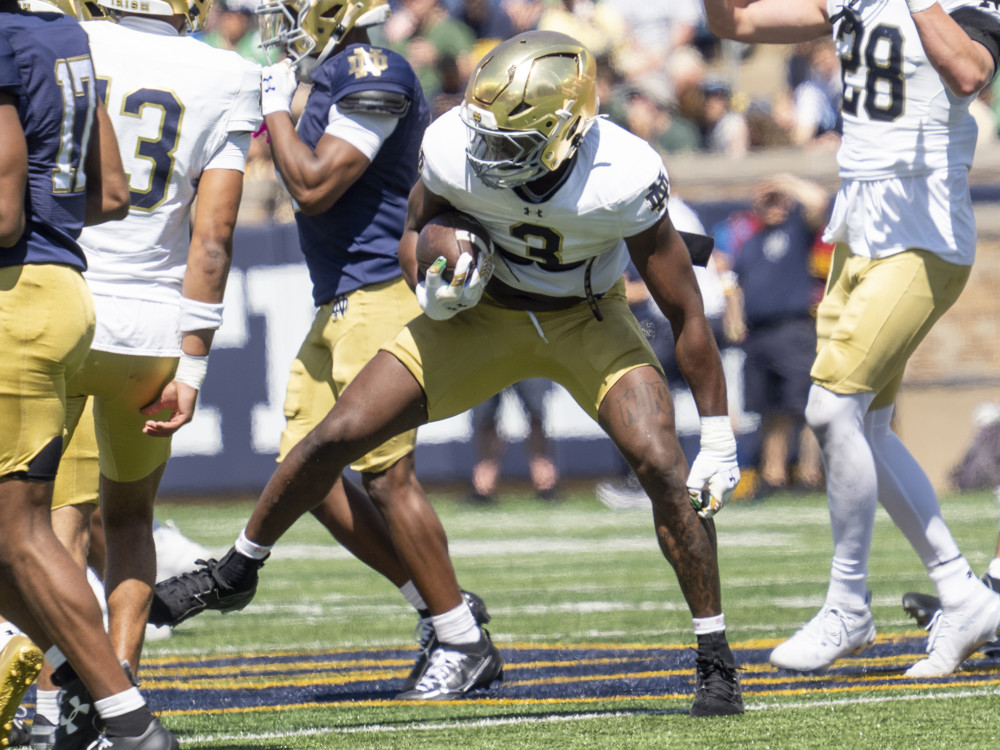
Saturday’s 94th edition of the Blue and Gold drew 45,308 to Notre Dame Stadium — the second-largest spring game crowd in program history — and the format produced the kind of split-squad scrimmage where the scoreboard is the least useful number on the page. What’s worth pulling out of the afternoon isn’t who won. It’s who played themselves into clearer roles, who didn’t, and which depth chart questions are closer to settled than they were a week ago.
Quarterbacks Hold Position
The quarterback room is at the top of that list, and it left Notre Dame Stadium in roughly the same position it arrived in. CJ Carr is the unquestioned starter with Blake Hebert and Noah Grubbs battling for the backup position.
Hebert actually had the cleanest afternoon of the three quarterbacks who took snaps, completing 7 of 11 for 103 yards and a touchdown, with no sacks taken and no interceptions. His 53-yard connection with Cam Williams was the longest pass play of the day and the only one that genuinely stretched the field. Noah Grubbs went 7-of-14 for 64 yards, throwing a 28-yard touchdown to Devin Fitzgerald and an interception that Ethan Long returned 20 yards. He also took two sacks. CJ Carr finished 7-of-15 for 55 yards with an interception to Jaylen Sneed and a sack from Loghan Thomas that wiped out a possession.
None of those lines is damning, and none of them is conclusive. The backup competition is what it was. What did get clearer is the receiver hierarchy behind it.
Receivers and Backs Start to Separate
Cam Williams’ 57 yards on three catches was the headline, but Devin Fitzgerald’s afternoon was the more complete one. Three targets, three catches, 54 yards, and a 28-yard touchdown that was the cleanest deep ball any of the three quarterbacks threw. Add an 11-yard slant on the same drive, and Fitzgerald looked the part of a player ready for a larger role rather than one auditioning for one. Elijah Burress chipped in two catches for 15 yards, including an 8-yard score from Hebert, and Mylan Graham and Logan Saldate picked up first downs in chunk-play situations.
The running back room tightened more.
Aneyas Williams led all rushers with 38 yards on 10 carries and a touchdown, plus three catches out of the backfield. Jonaz Walton was right behind at 33 yards on 11 carries with a score of his own. Between them, Williams and Walton accounted for 21 of the 32 Blue carries, and the workload split looked deliberate rather than situational. Walk-on Smith Kurtis added a few touches and an 11-yard reception. Xavier Southall got carries late. The depth behind the top two is still being sorted after injuries limited participation this spring.
Defenders Who Helped Themselves
The defensive side of the ball delivered the more interesting individual afternoons.
Jaylen Sneed led the Gold defense with four tackles and the interception of Carr that ended Blue’s worst possession of the day. Ethan Long’s 20-yard pick of Grubbs was the other takeaway and the kind of read-and-jump play that travels from April into August. Chaz Smith and Sneed both finished with multiple solo stops, Francis Brewu added three tackles, and Luke Talich was active across the back end with three tackles and a pass breakup.
Pressure Up Front, Production on the Back End
The pass rush showed up in a way that mattered.
Armel Mukam recorded a sack and a tackle for loss. Loghan Thomas got home for the sack on Carr that flipped field position. Keon Keeley and Rodney Dunham combined on the third sack, with half-TFLs apiece, and Cole Mullins and Sean Sevillano Jr. added tackles for loss of their own. Three sacks and five tackles for loss against three different quarterbacks isn’t an indictment of the offensive line or a revelation about the defensive line, but the list of names is worth tracking — and the names doing the work are the ones the program needs to keep developing if the front seven is going to take a real step.
The pass defense behind that front was just as productive. Eight pass breakups across the afternoon, with transfer Jayden Sanders leading the group with two and Adon Shuler, Mark Zackery IV, Luke Talich, and Ayden Pouncey each adding one. That’s competitive tape against the full quarterback rotation.
Useful Clarity, Not Final Answers
What Saturday didn’t answer is the question that always lingers after a Blue and Gold: How does the projected starting offense actually look against the projected starting defense, in real situations, with real stakes? The format prevents that, every year, by design. So the backup quarterback competition is exactly where it was at the start of the week, the offensive line gave up sacks in obvious passing situations without revealing whether that’s a personnel issue or a scheme issue, and the receiver rotation outside the top two is still loosely defined.
What the afternoon did produce is more useful than a verdict. The running back rotation looks like a tandem. Fitzgerald looked like an early enrollee ready to contribute. Sneed and Long made the kind of plays that get coaches’ attention. Mukam and Thomas got home. Eight pass breakups suggests a secondary that’s competitive on the perimeter even when the ball is being distributed across multiple quarterbacks.
Spring games should never be taken as a definitive sign of things to come — they produce a list of things to track into August. That, and a clean bill of health, is the most you should ever hope to walk out with, and that’s what we got from Notre Dame on Saturday.

Frank Vitovitch has been Co-Owner and Editor in Chief of UHND.com since joining forces with Kyle Flavin in 1999. Since that time, he has written over 2,000 articles covering Notre Dame football, recruiting, and basketball. He also works with all staff and external writers on all articles published on UHND.com. Frank's love for Notre Dame football started at a young age watching Rocket Ismail give opposing coaches ulcers in the late 1980's. By day Frank works in marketing and holds a degree in Digital Media from Drexel University. Frank's work has been cited by online/print editions of NBC Sports, ESPN, and Sports Illustrated and has been quoted on air by ESPN's Collin Cowherd. He's conducted interviews with Notre Dame legends Rocket Ismail, Randy Kinder, Lee Becton, Reggie Brooks, Michael Stonebreaker, and Ned Bolcar among others over his 20+ years of covering Notre Dame football. He's also been published in the print edition of USA Today Sports Weekly and the USA Today College Football Preview multiple times. Other Published Works/Citations for Frank Three Reasons Notre Dame Will Beat Alabama - USA Today Notre Dame Suspends WR Kevin Stepherson, RB C.J. Holmes Indefinitely - Bleacher Report Notre Dame / Ohio State Fiesta Bowl Preview - Eleven Warriors Brace Yourself: The Fighting Irish are Relevant Again - Sports on Earth Interviews with the Enemy: A Q&A with Frank Vitovitch of UHND - Yahoo! Sports Five Good Minutes: Notre Dame Football Preview With UHND.com - BC Interruption Vicious Electronic Questioning with UHND - MGO Blog
Comments
2 RESPONSESRelated coverage
 Notre Dame Football Highlights
: Irish Overwhelm Stanford With Dominant All-Phases Performance
Notre Dame Football Highlights
Notre Dame Football Highlights: Irish Overwhelm Stanford With Dominant All-Phases Performance
 Coach Interviews
Marcus Freeman Breaks Down Notre Dame’s Ground Game and CJ Carr’s Fourth-Down Play vs North Carolina
Coach Interviews
Marcus Freeman Breaks Down Notre Dame’s Ground Game and CJ Carr’s Fourth-Down Play vs North Carolina
 Notre Dame Football
By the Numbers: Jonaz Walton and the Run Game Carry Notre Dame Football Past North Carolina
Notre Dame Football
By the Numbers: Jonaz Walton and the Run Game Carry Notre Dame Football Past North Carolina
Can NBC bring in Ian Book on all the ND telecasts this year
Fitzgerald looks like he is going to be special.
He looks fast and smooth.