
Christopher Burgess Emerges in Notre Dame’s Defensive Tackle Battle
Chris Ash's spring comments made clear Burgess is no longer just a future project as Notre Dame sorts through its interior defensive line depth.

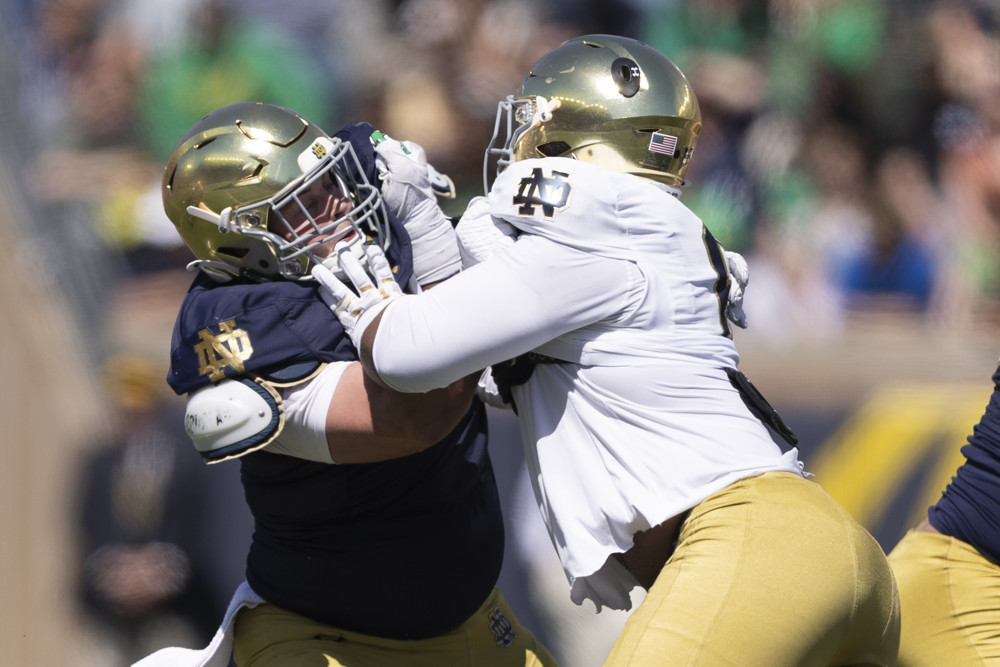
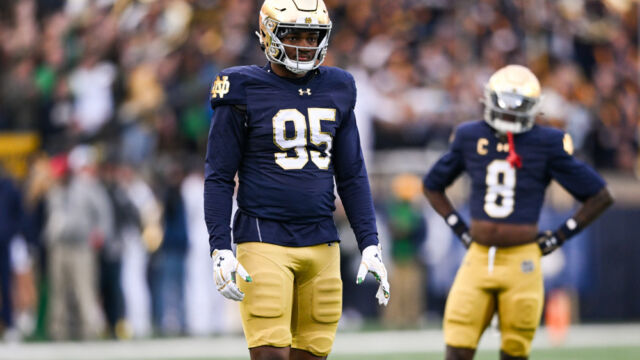
Christopher Burgess Jr. was easy to file away as a player Notre Dame wouldn’t need to rely on after they aggressively attacked the portal. That might be over. Chris Ash made it clear this spring that Burgess is now part of a real interior defensive line conversation. On a roster where the top of the tackle rotation has drawn most of the off-season attention, the fight for reps behind it is still wide open.
Notre Dame has bodies inside. What it does not have is a fully settled pecking order once you move past the obvious names and the portal additions like Francis Brewu and Tionne Gray. The next wave at defensive tackle is where camp can still change something, and Burgess has put himself in that mix.
From edge project to interior option
“He’s a young man that moved from the edge to interior D-line here this spring,” Ash said. “Played a little bit late in the season last year inside. He’s put on a lot of weight. He’s got a lot bigger and a lot stronger. We think he’s got a really bright future.”
A coach does not volunteer that much detail about a position change unless the player is forcing the issue. Burgess is not just learning a new position. He is being discussed as someone who may actually help sort out a room that still needs definition.
Ash spelled out the shape of the competition in one line: “We have a lot of depth on the interior D-line. It’s got to all sort out when we get through training camp.”
Why the defensive tackle battle matters
That is where this gets interesting for Notre Dame. Depth sounds comforting in April – especially with all the questions surrounding it before the portal opened. It gets a lot less comforting when the hierarchy is vague in August. Defensive tackle is one of those spots where coaches want answers fast because every other level of the defense depends on it. The linebackers need clean fits. The defensive backfield wants to spend less time in coverage. Third-down packages need somebody beyond the top options who can generate a rush inside.
Burgess gives Notre Dame a different kind of option because he was built on the edge and is now growing into the middle. The size jump matters. So does the fact that the staff apparently believes the transition is taking hold more quickly than expected.
“He’s really taken to the new coaching with Coach Partridge and what we’re asking him to do,” Ash said.
That quote carries more weight than the usual spring optimism because the move inside is not one of depth desperation. Interior line play demands different eyes, different hands, and different leverage. An edge player can win with space and burst. A tackle has to absorb double teams, anchor against downhill run schemes, and still know where his help is coming from.
Ash went further: “He’s really improved, and I think the sky’s the limit for him.”
Spring praise is cheap when it stays vague. Ash did not keep it vague.
“He’s made a lot of progress here throughout the spring. Understands his assignments,” Ash said.
That last part is the separator. Notre Dame has had plenty of defensive linemen flash in spring ball. The ones who actually crack the rotation are the ones coaches trust to line up correctly, handle movement, and avoid blowing the structure of the defense. Assignment soundness is the price of admission inside, especially for a player changing positions.
A real shot when camp opens
Burgess still has to prove it in a full training camp, where the reps get harder, the run game gets heavier, and every missed fit gets noticed. But he has moved beyond the “maybe later” category. Ash closed the door on that.
“I can’t wait to see what he does in training camp.”
Neither can Notre Dame, because this room needs one more answer. Burgess has given himself a shot to be it.

Frank Vitovitch has been Co-Owner and Editor in Chief of UHND.com since joining forces with Kyle Flavin in 1999. Since that time, he has written over 2,000 articles covering Notre Dame football, recruiting, and basketball. He also works with all staff and external writers on all articles published on UHND.com. Frank's love for Notre Dame football started at a young age watching Rocket Ismail give opposing coaches ulcers in the late 1980's. By day Frank works in marketing and holds a degree in Digital Media from Drexel University. Frank's work has been cited by online/print editions of NBC Sports, ESPN, and Sports Illustrated and has been quoted on air by ESPN's Collin Cowherd. He's conducted interviews with Notre Dame legends Rocket Ismail, Randy Kinder, Lee Becton, Reggie Brooks, Michael Stonebreaker, and Ned Bolcar among others over his 20+ years of covering Notre Dame football. He's also been published in the print edition of USA Today Sports Weekly and the USA Today College Football Preview multiple times. Other Published Works/Citations for Frank Three Reasons Notre Dame Will Beat Alabama - USA Today Notre Dame Suspends WR Kevin Stepherson, RB C.J. Holmes Indefinitely - Bleacher Report Notre Dame / Ohio State Fiesta Bowl Preview - Eleven Warriors Brace Yourself: The Fighting Irish are Relevant Again - Sports on Earth Interviews with the Enemy: A Q&A with Frank Vitovitch of UHND - Yahoo! Sports Five Good Minutes: Notre Dame Football Preview With UHND.com - BC Interruption Vicious Electronic Questioning with UHND - MGO Blog
Comments
BE FIRST TO RESPOND