Notre Dame vs. Michigan State Football Rivalry History: The Battle for the Megaphone
The Megaphone, the 26-year hiatus, the Game of the Century, and how Michigan's grudge against both schools turned two neighbors into regular opponents.

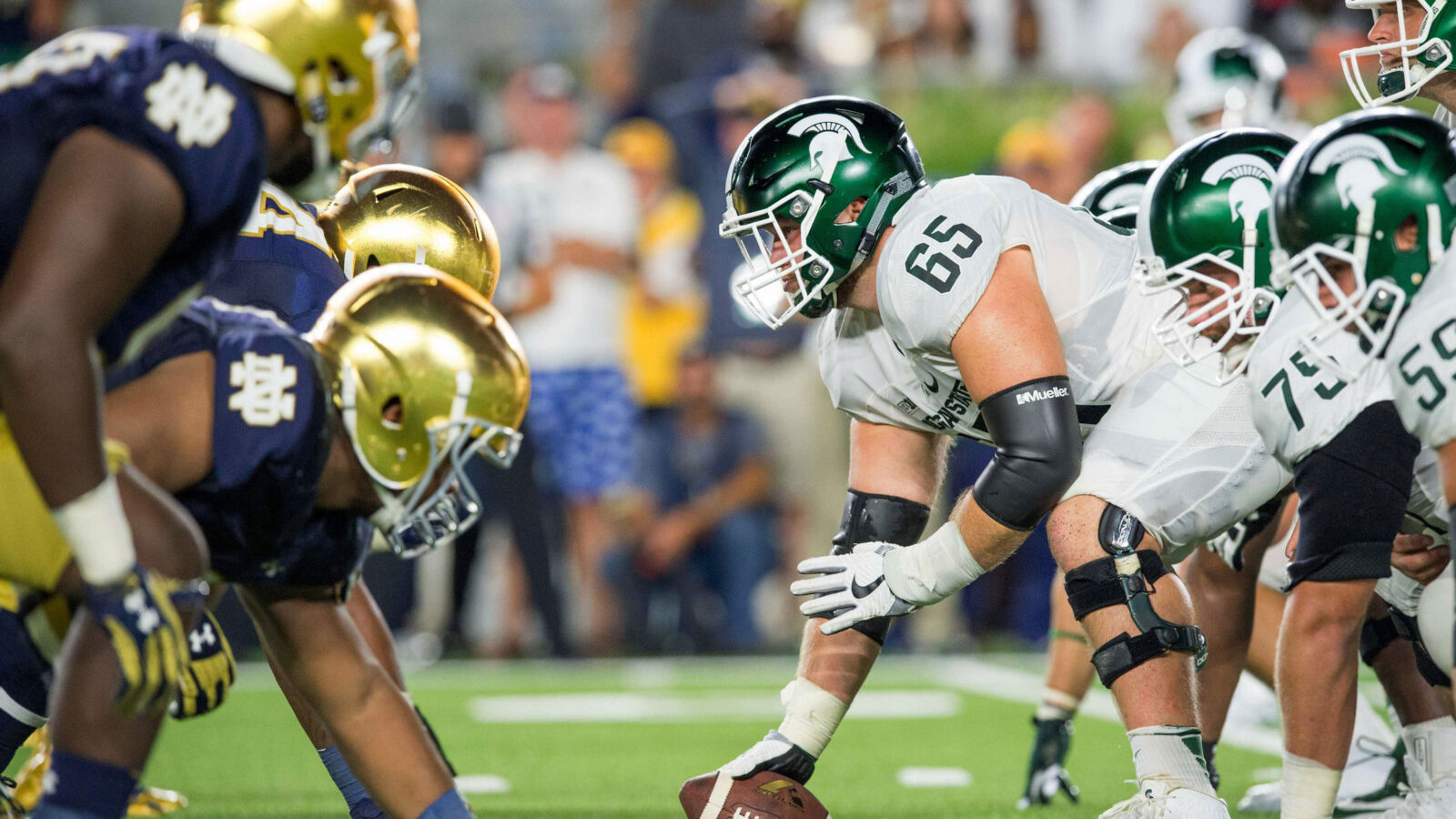
Notre Dame and Michigan State play again on September 19, 2026, for the first time since 2017. Nine years is a long time between meetings for two programs that spent the postwar era playing nearly every fall, but it is not the longest break in this series. The teams did not meet at all between 1921 and 1948.
The Irish lead 49-29-1 across 79 meetings dating to 1897, and have played Michigan State nearly twice as many times as they have played Michigan. The series is older than the feud that shaped it, but it endured in large part because of a third school that wanted neither of them.
The enemy of my enemy
Fielding Yost spent the better part of two decades trying to keep Notre Dame out. Michigan leaned on the Western Conference, the Big Ten’s original name, to reject Notre Dame’s membership petition in 1908. It cancelled the 1910 game a day before kickoff over a dispute about ineligible Irish players, and then did not put Notre Dame back on the schedule for 33 years. Yost pushed the rest of the conference to do the same, and for a long stretch most of it went along. Notre Dame did not play another conference school until a scoreless tie with Wisconsin in 1917.
Michigan State kept playing them straight through all of it.
The Spartans were getting a version of the same treatment, just on different grounds. Michigan wanted to be the state legislature’s favorite, and it lobbied hard against expanding aid to Michigan State and funding its programs, agricultural and otherwise. Michigan State was voted into the Big Ten in 1949 and became a member in 1950, but it did not play a conference football schedule until 1953. If you want to know why it took that long, you will not find the answer in East Lansing or Chicago. You will find it in Ann Arbor.
None of that made Notre Dame and Michigan State friends exactly, but it made them useful to each other, and the two programs had an easy working relationship for decades. Sleepy Jim Crowley, one of Rockne’s Four Horsemen, coached the Spartans from 1929 to 1932.
Biggie Munn and the Spartan decade
Michigan State’s timing could not have been much better. The postwar boom was pulling workers into Detroit, Flint and Saginaw from all over the country, and plenty of them brought big, athletic sons along with them. Clarence “Biggie” Munn took over in East Lansing in 1947, right as that talent started showing up in state. Munn had played for Fritz Crisler at Minnesota and coached under him at Michigan, and he won national championships with the Spartans in 1951 and 1952.
Munn was rising just as Frank Leahy’s run was coming to an end. Munn and his protege Duffy Daugherty owned the series: from 1950 through 1963, Michigan State beat Notre Dame eleven times in twelve meetings. Irish fans of that era grew up losing this game.
Then Notre Dame hired Ara Parseghian, and the tide turned back towards the Irish. He went 8-2-1 against the Spartans over eleven seasons.
1966: the Game of the Century
The series’ defining afternoon came on November 19, 1966, when No. 1 Notre Dame and No. 2 Michigan State met in East Lansing with the national championship on the line and played to a 10-10 tie. An estimated 33 million people watched, the largest television audience college football had drawn to that point.
Michigan State put four players in the top eight picks of the 1967 draft: Bubba Smith first overall, Clint Jones second, George Webster fifth, Gene Washington eighth. Notre Dame had three first-rounders of its own, Paul Seiler 12th, Alan Page 15th and Tom Regner 23rd, and Jim Lynch won the Maxwell Award that season as a unanimous All-American. Parseghian ran out the clock rather than risk it, and answered for that decision for the rest of his career.
Read the full story of the 1966 Game of the Century →
Irish and Spartans exchange periods of dominance
From 1969 through 1994 the teams met every year, and Notre Dame lost three times, finishing 23-3 across 26 meetings. A generation raised on those wins knew only beating up on Michigan State, even if plenty of those games were close.
After a two-year break the series resumed and the Spartans started fighting back. From 1997 to 2010 Michigan State went 10-4 against the Irish, taking advantage of a stretch in which Bob Davie, Tyrone Willingham and Charlie Weis were each fired before their contracts ended.
Over the final five meetings before the series paused in 2017, Notre Dame recovered some of it at 4-1.
Thrilling moments in the 2000s
2000: Bob Davie dialed up an all-out blitz on fourth-and-10 inside two minutes, Jeff Smoker beat it, and Herb Haygood went 68 yards for the touchdown that finished the Irish.
2002: Pat Dillingham, a walk-on, came off the bench and found Arnaz Battle, a quarterback playing receiver, for 60 yards with 1:15 left to steal one in East Lansing.
2005: Notre Dame climbed out of a 38-17 hole to force overtime and lost anyway, 44-41. Then Eric Smith and Kaleb Thornhill ran a Michigan State flag out to midfield and planted it in Notre Dame Stadium. John L. Smith said afterward that he would not have encouraged it, and that the right celebration would have been hoisting the Megaphone, except the trophy was not in the building that day.
2006: Down big to the Spartans for the second straight year, and with a year of flag footage behind them, Notre Dame got a Jeff Samardzija touchdown at 8:18 of the fourth and then won it on Terrail Lambert’s 27-yard interception return with 2:53 left.
2009: Jimmy Clausen found Golden Tate in the corner of the end zone to put Notre Dame ahead with 5:28 to play, and Tate, who had no idea the Spartan band was stacked up that close to the sideline, got his feet down and launched himself headfirst into it. Charlie Weis had one note afterward: it was the wrong band. Kirk Cousins then had the end zone in front of him and threw the interception that ended it.
2010: Michigan State ran the “Little Giants” fake field goal in overtime and got away with it. Notre Dame’s complaint was the play clock, which looked like it hit zero before the snap. The conference reviewed it and backed the crew.
2013: Notre Dame handed Michigan State its only loss in the last year of the BCS, which is why the Spartans spent New Year’s Day in Pasadena instead of playing for the title.
The Megaphone Trophy
The teams have played for the Megaphone Trophy since 1949, when the alumni clubs of both schools put it up to go to the winner each year. It is a simple thing: a megaphone split down the middle, Notre Dame’s side blue and Michigan State’s green, with the scores of each meeting painted on as the series went along.
The trophy is also the honest measure of this rivalry. Notre Dame’s 49-29-1 all-time lead is inflated by the early decades, when the Irish were a national program and Michigan State was still trying to become one. Since 1949 the margin is 35-27-1 across 63 meetings, and it has swung in long stretches rather than trading years.
Which makes the last nine years the strangest chapter in its history. Notre Dame won in 2017, took the Megaphone home, and the series stopped. It has sat in South Bend ever since, undefended, because nobody has been able to play for it.
September 19, 2026
Saturday is the first chance anyone has had to take it back, and the two programs arrive at it from completely different places.
They did not in 2017. Notre Dame was coming off a 4-8 season that nearly cost Brian Kelly his job. Michigan State had just gone 3-9, Dantonio’s worst year and the end of the run that had taken the Spartans to a Rose Bowl and a Playoff. The Irish won 38-18 and both programs looked like they were on their way back up.
Only one of them got there. Michigan State is on its fourth head coach since that night, with Pat Fitzgerald now the one trying to rebuild it. Notre Dame comes in 2-0, ranked third, and favored by nearly 30 points.
Notre Dame vs. Michigan State: every meeting
All 79 meetings, 1897 through 2017. Notre Dame leads 49-29-1. Full series data also lives on the Michigan State opponent page.

Frank Vitovitch has been Co-Owner and Editor in Chief of UHND.com since joining forces with Kyle Flavin in 1999. Since that time, he has written over 2,000 articles covering Notre Dame football, recruiting, and basketball. He also works with all staff and external writers on all articles published on UHND.com. Frank's love for Notre Dame football started at a young age watching Rocket Ismail give opposing coaches ulcers in the late 1980's. By day Frank works in marketing and holds a degree in Digital Media from Drexel University. Frank's work has been cited by online/print editions of NBC Sports, ESPN, and Sports Illustrated and has been quoted on air by ESPN's Collin Cowherd. He's conducted interviews with Notre Dame legends Rocket Ismail, Randy Kinder, Lee Becton, Reggie Brooks, Michael Stonebreaker, and Ned Bolcar among others over his 20+ years of covering Notre Dame football. He's also been published in the print edition of USA Today Sports Weekly and the USA Today College Football Preview multiple times. Other Published Works/Citations for Frank Three Reasons Notre Dame Will Beat Alabama - USA Today Notre Dame Suspends WR Kevin Stepherson, RB C.J. Holmes Indefinitely - Bleacher Report Notre Dame / Ohio State Fiesta Bowl Preview - Eleven Warriors Brace Yourself: The Fighting Irish are Relevant Again - Sports on Earth Interviews with the Enemy: A Q&A with Frank Vitovitch of UHND - Yahoo! Sports Five Good Minutes: Notre Dame Football Preview With UHND.com - BC Interruption Vicious Electronic Questioning with UHND - MGO Blog
Related coverage
 Notre Dame Football
Notre Dame vs. Pittsburgh Rivarly: Over a Century of Battles and Irish Dominance
Notre Dame Football
Notre Dame vs. Pittsburgh Rivarly: Over a Century of Battles and Irish Dominance
 Notre Dame Football Rivalries
Notre Dame vs. Miami Rivaly: One of College Football’s Most Contentious Rivalries
Notre Dame Football Rivalries
Notre Dame vs. Miami Rivaly: One of College Football’s Most Contentious Rivalries
 Notre Dame Football Rivalries
Old Independent Rivals: The Notre Dame – Penn State Football Rivalry
Notre Dame Football Rivalries
Old Independent Rivals: The Notre Dame – Penn State Football Rivalry
Comments
BE FIRST TO RESPOND