Assessing Notre Dame’s 2026 Offensive Line Amid NFL Departures

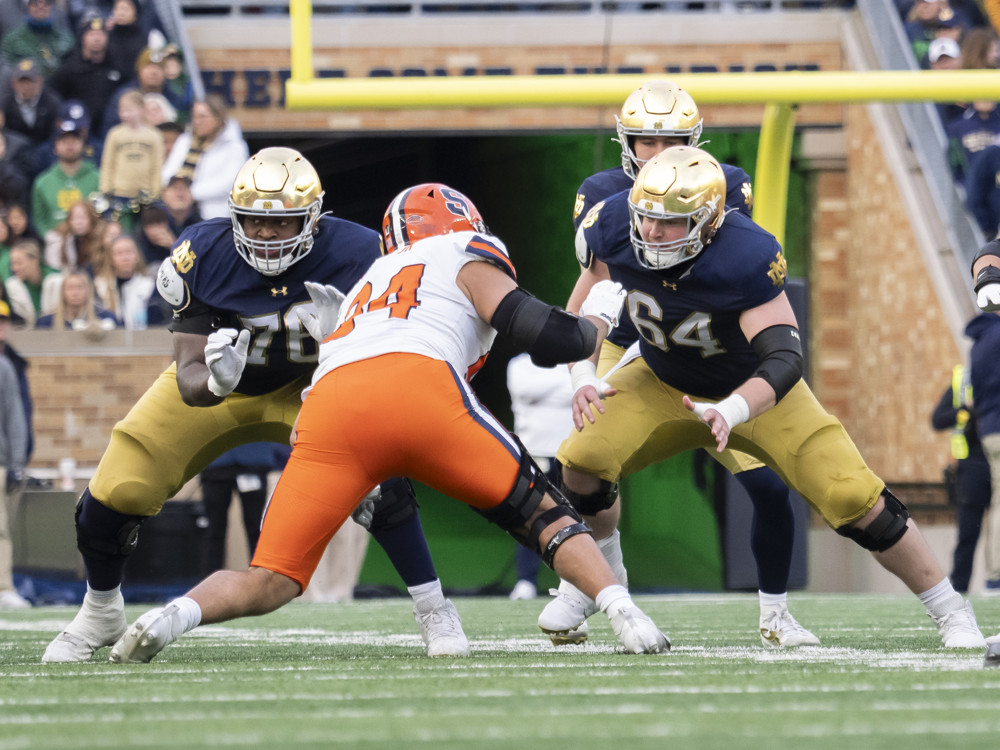
Projecting an offensive line a full season in advance is always an exercise in probabilities rather than certainties, and that is especially true for Notre Dame heading into 2026. With Aamil Wagner and Billy Schrauth both off to the NFL, the Irish enter the offseason with two obvious vacancies and a number of internal options that make the picture clearer — but not settled.
This is not a situation where Notre Dame is starting from scratch. There is experience, depth, and positional flexibility on the roster. Notre Dame returns five players who have started games before – two of whom started in the national championship game last year. The challenge for Marcus Freeman and his staff will be aligning those pieces in a way that balances short-term reliability with long-term development. Here is how the 2026 offensive line could come together, where the strengths are most likely to emerge, and where the legitimate concerns remain.
A Stable Starting Point at Left Tackle
Any assessment of Notre Dame’s 2026 offensive line has to begin with Anthonie Knapp. With Wagner’s departure, Knapp returns as the most established lineman on the roster and the clear anchor at left tackle.
Knapp’s value goes beyond simply occupying a premium position. He provides continuity in pass protection, a reliable presence in the run game, and leadership in a room that will otherwise be in flux. Having the blind side secured allows the staff to be more flexible elsewhere, particularly on the interior, where multiple players may be learning new roles. Knapp has started playoff games. He’s started road games in College Station and Miami. He’s about as battle-tested as an offensive lineman can be heading into their junior season.
There may be competition at nearly every other spot, but left tackle is the one position Notre Dame can reasonably feel confident about entering 2026 – if they want to. Knapp has never had the ideal size for a left tackle, and if he has NFL aspirations, a move is almost certainly in his future, whether that’s while at Notre Dame or at the next level. It’s possible Notre Dame explores guard or center for Knapp, but at this point seems unlikely as the staff reportedly likes Knapp only at LT.
Still, it was hard to watch Miami’s massive OL manhandle Ohio State last night and not think that it would be wise to at least consider such a move if the staff feels good about at LT. At the same time, one could also argue that seeing Ohio State’s tackles look like statues at times, trying to slow down Rueben Bain Jr, reinforces why the Irish staff is OK sacrificing some size with Knapp in exchange for his athleticism.
Left Guard: Upside Tempered by Availability
If there is a position that best captures the balance between optimism and caution for this line, it is left guard. Charles Jagusah remains the most intriguing internal option, but his availability cannot be taken for granted.
Jagusah’s trajectory has been repeatedly interrupted by injuries, and the complications that limited him in 2025 only reinforce the need for guarded expectations. From a schematic standpoint, guard is the ideal spot to try to maximize his physical traits, though an argument could be made that he is built for tackle. If he is healthy, Notre Dame’s interior takes a meaningful step forward. If not, the staff must be ready to pivot quickly without destabilizing the entire unit.
Jagusah has NFL potential if he can stay on the field, but he has not been able to do that the last two seasons. His off-season injury, suffered off the field, kept him out all year, even though the staff was counting on him to start heading into camp. Initially slated for a mid-October return, complications in his recovery totally derailed his season and his development once again. To date, Jagusah has started just two games in his career – the Sun Bowl in 2023 and the national championship game last year.
Center Stability Provides a Safety Net
While much of the focus will land on guard and tackle, center is where Notre Dame can feel quietly confident. Joe Otting proved in 2025 that he could handle the position after stepping in for Ashton Craig.
Otting’s reliability in protection calls and interior blocking gives the line a much-needed anchor in the middle. With questions on either side of him, that steadiness becomes even more important. It allows Notre Dame to manage risk elsewhere without compromising the basic functioning of the offense. It will be fascinating to watch the battle between Craig and Otting this spring and fall. Craig, like Jagusah, has had a hard time staying on the field, and Otting did everything he could to stake his claim to a starting role in 2026 with his performance down the stretch. Either could also factor in the competition at guard, depending on how center shakes out.
A Developmental Window at Right Guard
Right guard may represent the clearest opportunity for growth in 2026, with Will Black positioned as a potential contributor. This would not be a declaration that Black is fully formed, but rather an acknowledgment that guard is often the best place to introduce a young lineman with long-term upside.
With experienced players potentially flanking him, Black could be brought along deliberately. Some early inconsistency would be expected, but the surrounding structure could help absorb those growing pains. Black came to Notre Dame as the LT of the future, but that could still be a year away for Black if Knapp stays at LT and anchors the line. Guerby Lambert came to Notre Dame as a tackle and started at guard last year, too, so there is some recent precedent.
Right Tackle and the Search for Continuity
Replacing Wagner’s experience at right tackle will be one of the more closely watched battles of the offseason. Guerby Lambert appears to be a natural internal candidate after gaining valuable reps at guard all season. It wasn’t the smoothest start to the season for him, but he came on strong down the stretch and looks like another future NFL lineman for OL U.
Lambert’s versatility gives the staff options, but right tackle is a position that rewards continuity. If he can establish himself early, it would allow the rest of the line to develop without constant reshuffling — something Notre Dame has not always enjoyed in recent seasons.
Matty Augustine is another freshman whom the staff feels very good about long-term. He will factor into the mix in 2026 even if it is just in a reserve role. As we’ve seen over the last few years, Notre Dame will likely need at least a couple of backups ready to start multiple games.
Coaching Context: Development vs. Early-Season Growing Pains
Any projection of Notre Dame’s offensive line must account for the influence of offensive line coach Joe Rudolph. Over the years, Rudolph has consistently shown the ability to develop linemen, refine technique, and elevate groups over the course of a season. That track record is a major reason for confidence that this unit can improve as 2026 progresses.
At the same time, recent history suggests caution. Notre Dame has experienced early-season offensive line issues more than once, often while young players were acclimating or while new combinations were still settling in. That pattern raises reasonable concern that the 2026 line could take time to find its footing, particularly if injuries or inexperience force shuffling early in the year.
Both realities can be true. Rudolph’s lines tend to get better, but they have not always started fast.
A Measured Outlook for 2026
Taken together, Notre Dame’s 2026 offensive line projects as a group with a high floor and a ceiling that depends heavily on health and development. Anthonie Knapp and Joe Otting provide stability at two critical positions. Players like Charles Jagusah, Will Black, and Guerby Lambert represent variables that will determine how quickly the line can become a strength rather than simply functional. On paper, it could be one of the best offensive lines Notre Dame has had since it won the Joe Moore Award in 2017.
There is enough proven coaching and internal depth to avoid panic, but also enough uncertainty to warrant concern. Assessing this unit now requires restraint. The most likely outcome lies somewhere between early growing pains and meaningful late-season improvement — a familiar pattern, but one Notre Dame will hope to manage more smoothly in 2026.

Frank Vitovitch has been Co-Owner and Editor in Chief of UHND.com since joining forces with Kyle Flavin in 1999. Since that time, he has written over 2,000 articles covering Notre Dame football, recruiting, and basketball. He also works with all staff and external writers on all articles published on UHND.com. Frank's love for Notre Dame football started at a young age watching Rocket Ismail give opposing coaches ulcers in the late 1980's. By day Frank works in marketing and holds a degree in Digital Media from Drexel University. Frank's work has been cited by online/print editions of NBC Sports, ESPN, and Sports Illustrated and has been quoted on air by ESPN's Collin Cowherd. He's conducted interviews with Notre Dame legends Rocket Ismail, Randy Kinder, Lee Becton, Reggie Brooks, Michael Stonebreaker, and Ned Bolcar among others over his 20+ years of covering Notre Dame football. He's also been published in the print edition of USA Today Sports Weekly and the USA Today College Football Preview multiple times. Other Published Works/Citations for Frank Three Reasons Notre Dame Will Beat Alabama - USA Today Notre Dame Suspends WR Kevin Stepherson, RB C.J. Holmes Indefinitely - Bleacher Report Notre Dame / Ohio State Fiesta Bowl Preview - Eleven Warriors Brace Yourself: The Fighting Irish are Relevant Again - Sports on Earth Interviews with the Enemy: A Q&A with Frank Vitovitch of UHND - Yahoo! Sports Five Good Minutes: Notre Dame Football Preview With UHND.com - BC Interruption Vicious Electronic Questioning with UHND - MGO Blog
Related coverage
 Notre Dame Offensive Line
Freeman’s Offensive Checklist for Wisconsin: Ball Security, Discipline, and Clean Operation
Notre Dame Offensive Line
Freeman’s Offensive Checklist for Wisconsin: Ball Security, Discipline, and Clean Operation
 Notre Dame Offensive Line
Notre Dame’s Interior Line Options After Matty Augustine Went Down
Notre Dame Offensive Line
Notre Dame’s Interior Line Options After Matty Augustine Went Down
 Notre Dame Offensive Line
Mike Denbrock Says Notre Dame Right Guard Battle May Last Deep Into Camp
Notre Dame Offensive Line
Mike Denbrock Says Notre Dame Right Guard Battle May Last Deep Into Camp
Comments
BE FIRST TO RESPOND