
Backup Plan at Kicker: Freeman Defines Notre Dame’s Path Forward
Burnette ramps with monitored reps; if he can’t go, Freeman will choose between Schmidt and Diomede after pressure kicks in practice.

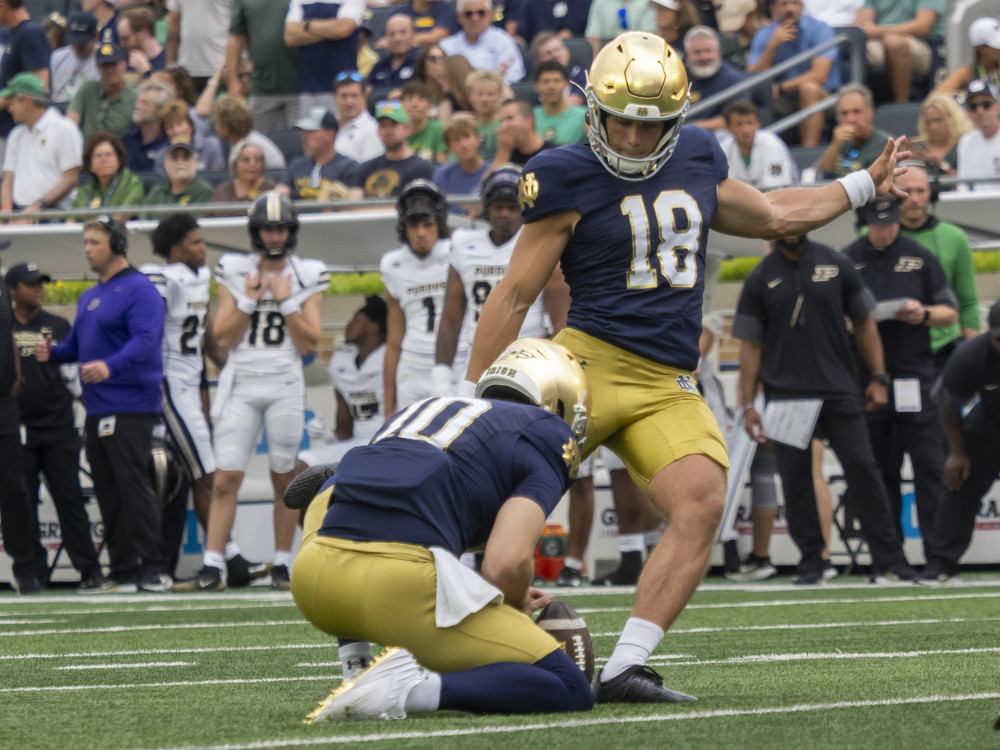
In 2024, Notre Dame’s kicking game wobbled when grad transfer Mitch Jeter hurt his groin at Stanford in mid-October. Freeman confirmed the groin tightness postgame, and Jeter’s availability/consistency seesawed afterward. By mid-November, Freeman acknowledged Jeter still wasn’t 100 percent.
Reporting around the injury painted the picture of a tricky hip/groin recovery window that bled into performance down the stretch. Fast forward to 2025: starter Noah Burnette has been dealing with a lingering right-hip issue, re-aggravated in practice the week of Boise State, which made him a late scratch—for the second time in three weeks.
Freeman’s message this time wasn’t “bad luck”; it was cause-and-effect, with a clear non-negotiable: “You can’t go weeks without kicking and expect to make it in the game.” In other words, if Burnette is going to play, he has to practice enough to be truly ready.
Similarities vs. Differences
What’s the same: soft-tissue, lower-body issues derailing the operation midseason and forcing week-to-week decisions.
What’s different: Freeman doesn’t want to bubble-wrap the position. The plan is to build Burnette back with monitored volume and to end the open competition behind him—naming one kicker so the operation (snap/hold/strike) gets real rhythm during the week.
Who’s Next If Burnette Can’t Go?
Freeman indicated the contingency is between Erik Schmidt and Marcello Diomede—and that the staff will stop hedging and pick one. The idea: script high-leverage kicks (end-of-half, two-minute, “gotta-have-it”) in front of the full team so Saturday feels familiar. Recent usage and results explain the urgency: through Oct. 4, Schmidt is 0-for-1 on field goals (a 31 yarder), while Burnette is 3-for-3 on FGs and 13-for-13 on PATs. Schmidt had a PAT blocked against Boise State on a very low kick, prompting Freeman to insert Diomede for the final two attempts.
End the Hedge Behind Noah
The contingency plan is settling on a permanent replacement and moving forward. Freeman said the weeks-long competition behind the starter needs to stop if the starter can’t go: “If Noah can’t go, this is going to be the guy. I, as the head coach, got to have confidence in that person. Our team has to have confidence, and that young person has to have confidence.” Waiting for practice stats to deliver a perfect answer isn’t realistic. Make the call. Build the week around it.
After a “long conversation” with special teams coordinator Marty Biagi, Freeman signaled a simple path: create pressure reps, not just leg swings. Script end-of-half, two-minute, and “gotta have it” kicks inside full-team periods. Let everyone see them. Confidence is earned and observed; the locker room needs to feel the No. 2 is ready if called.
Help Your Kicker by Stopping Self-Inflicted Wounds
Freeman tied the specialist conversation to the larger discipline issue. “Every drive that we didn’t have one penalty we scored a touchdown.” Fewer flags and minus plays mean shorter attempts, cleaner hashes, and fewer must-make bombs. Don’t “beat Notre Dame” with pre-snap errors and then ask the kicker to bail it out from the paint.
Two seasons, similar headache. The difference is the blueprint. Last year, Jeter battled the groin and never quite felt fully right down the stretch until the College Football Playoffs. This year, Freeman’s plan is explicit: get Burnette practicing enough to be game-ready; if he can’t go, pick one leg (Schmidt or Diomede), give him pressure reps, and stabilize the operation. Hopefully, that is how this stops being a weekly storyline.

Frank Vitovitch has been Co-Owner and Editor in Chief of UHND.com since joining forces with Kyle Flavin in 1999. Since that time, he has written over 2,000 articles covering Notre Dame football, recruiting, and basketball. He also works with all staff and external writers on all articles published on UHND.com. Frank's love for Notre Dame football started at a young age watching Rocket Ismail give opposing coaches ulcers in the late 1980's. By day Frank works in marketing and holds a degree in Digital Media from Drexel University. Frank's work has been cited by online/print editions of NBC Sports, ESPN, and Sports Illustrated and has been quoted on air by ESPN's Collin Cowherd. He's conducted interviews with Notre Dame legends Rocket Ismail, Randy Kinder, Lee Becton, Reggie Brooks, Michael Stonebreaker, and Ned Bolcar among others over his 20+ years of covering Notre Dame football. He's also been published in the print edition of USA Today Sports Weekly and the USA Today College Football Preview multiple times. Other Published Works/Citations for Frank Three Reasons Notre Dame Will Beat Alabama - USA Today Notre Dame Suspends WR Kevin Stepherson, RB C.J. Holmes Indefinitely - Bleacher Report Notre Dame / Ohio State Fiesta Bowl Preview - Eleven Warriors Brace Yourself: The Fighting Irish are Relevant Again - Sports on Earth Interviews with the Enemy: A Q&A with Frank Vitovitch of UHND - Yahoo! Sports Five Good Minutes: Notre Dame Football Preview With UHND.com - BC Interruption Vicious Electronic Questioning with UHND - MGO Blog
Comments
BE FIRST TO RESPOND